From sellers not being honest, to professionals not caring for their animals, to boarding barn drama I've watched quite a bit of negative stuff unfold on social media recently.
Choosing a professional to work with can be daunting (with so much at stake) but there are a few things horse lovers can look for to hopefully avoid getting taken advantage of.
1. Selling green horses/unbroke (old enough to be started) without at least 30 days of riding.- A reputable trainer knows that takes months and years to create a solid mount and that you can not know a horse's true nature, deposition, and ability in just a few rides. Those who offer horses with less than 30 days are usually more interested in the money than the horse and the person who ends up buying them.
2. In depth Testimonials- It's super easy to say someone is great. Look for testimonials with real sustenance and reasons why someone is great instead of generic buzz words. And of course the more in depth/detailed testimonials the better.
3. References and Referrals- A reputable trainer should have scores of happy customers of whom are more than willing to share their experiences with others if asked. If you are considering putting a horse into training or buying one ask to be put in contact (or seek them out for yourself) with people who have done the same.
4. How they keep and talk about their own horses- Is every horse on the place (unless a single rescue or two in rehab) in excellent shape? Are they super secretive about their horse life? If they are on facebook (and use it regularly) do they talk about and share their personal horse life like a regular horse lover?
5. If they regularly offer horses for sale who is buying them?- A professional with a good local reputation will usually have local/regional people seeking out and buying their horses.
6. How and how often they advertise?- Everyone has to start somewhere but if a professional has been in business for awhile and has a good reputation they usually don't have to advertise for new clients every single week.
7. General life stability/ consistency- Everyone moves from time to time and has an occasional rough patch but constant turmoil and change in a professional's personal and or professional life can also be a red flag.
8. Birds of a feather tend to flock together- shady professionals usually get a long fairly well other shady professionals. A person's personal and professional connections can provide some insight into one's character.
9. Can you see the results/ improvement?- If you run across clients of a professional and or horse's they've sold how are they? Every professional has a few clients who don't listen (or are not there best representation as to what they can do depending on the circumstances) but as a whole their should be some constancy in a professional's work as seen by the public. If someone you know starts working with a professional can you see good improvement at a reasonable pace (considering the circumstances)?
10. Talk with other equine professionals- Farriers, feed stores, and other equine service professionals can provide much needed insight into the real workings and business practices of a professional you are considering working with.
Of course the above list is only one person's opinion and cannot be accurately applied to every equine professional in every situation, but in creating this list I hope to help horse owners seeking help and horses to avoid getting taken advantage of by those who give the profession as a whole a bad reputation.
Wednesday, August 20, 2014

Wednesday, July 30, 2014
Why I haven't been doing groundwork with the 15 month old colt
Why I haven't been doing groundwork with the 15 month old colt.
Yes, you read the title right.
At 15 months of age I haven't done any Anderson/Parelli/Anyone Else style groundwork with Mozzie. He hasn't been lunged or schooled in any games or published exercises.
To be quite frank at 15 months of age I don't NEED him to do any of those things. The month before I start him under saddle when his knees have closed is when I will really hunker down and teach him all that. But until then I have tried my best to grow his mind in other ways.
Instead of groundwork he has...
Tied- Tied to the trailer, the fence (secure of course), trees, on a high line, etc and at multiple locations.
Lived in the herd- Mozzie has been in over 5 different herds (horse combinations). As a result he has learned equine language, herd dynamic, and all around horsey (grumpy mare) etiquette.
Traveled- He has hauled numerous times in 3 different trailers to multiple locations.
Learned basic life skills- Leading respectfully, bathing, blanketing, fly spraying, clipping, hoof trimming, grooming, etc.
Learned to respect people- Both when in hand and loose in the pasture. He yields to pressure and is very respectful of space.
Ponied- He has been ponied off several horses in different groups of horses, crossed multiple bodies of water, and numerous hills and other varied terrain where he has learned the value of watching his step and watched countless good role models tackle those same feats.
Desensitized- He has been in plastic bottle boxes, cowboy curtains, pool noodle car washes, and experienced countless other spooks.
Yes, you read the title right.
At 15 months of age I haven't done any Anderson/Parelli/Anyone Else style groundwork with Mozzie. He hasn't been lunged or schooled in any games or published exercises.
To be quite frank at 15 months of age I don't NEED him to do any of those things. The month before I start him under saddle when his knees have closed is when I will really hunker down and teach him all that. But until then I have tried my best to grow his mind in other ways.
Instead of groundwork he has...
Tied- Tied to the trailer, the fence (secure of course), trees, on a high line, etc and at multiple locations.
Lived in the herd- Mozzie has been in over 5 different herds (horse combinations). As a result he has learned equine language, herd dynamic, and all around horsey (grumpy mare) etiquette.
Traveled- He has hauled numerous times in 3 different trailers to multiple locations.
Learned basic life skills- Leading respectfully, bathing, blanketing, fly spraying, clipping, hoof trimming, grooming, etc.
Learned to respect people- Both when in hand and loose in the pasture. He yields to pressure and is very respectful of space.
Ponied- He has been ponied off several horses in different groups of horses, crossed multiple bodies of water, and numerous hills and other varied terrain where he has learned the value of watching his step and watched countless good role models tackle those same feats.
Desensitized- He has been in plastic bottle boxes, cowboy curtains, pool noodle car washes, and experienced countless other spooks.
Wednesday, July 9, 2014

Wednesday, June 18, 2014
The Horse Course- Free Educational Opportunities
It is no secret that I love learning and that I have spent most of my life studying all aspects of the horse.
Recently I stumbled upon Coursera, a completely free online database with college courses being offer on every subject imaginable taught by facility from over 80 universities from across the globe. (I'm also taking a baby nutrition and cooking course found here. This is the best website I've found in years.)
This month I have been taking the The Horse Course offer by the University of Florida and have really enjoyed it.
And later I will also be taking the Equine Nutrition Course being offered early next year by the University of Edinburgh.
What are some ways that you continue your equine education?
Recently I stumbled upon Coursera, a completely free online database with college courses being offer on every subject imaginable taught by facility from over 80 universities from across the globe. (I'm also taking a baby nutrition and cooking course found here. This is the best website I've found in years.)
This month I have been taking the The Horse Course offer by the University of Florida and have really enjoyed it.
And later I will also be taking the Equine Nutrition Course being offered early next year by the University of Edinburgh.
What are some ways that you continue your equine education?
Friday, May 30, 2014
I Like The Sound That You Make- All Your Horse Really Wants
 |
| not my image, thanks internet! |
I really couldn't put it any better myself.
All your horse wants is for you to shut up.
He looks for ways every ride to get you to quit.
If you just shut up when he is doing it right, he will do it again to shut you up in the future.
By quitting at the right time and not pestering him (micromanaging) when he is doing it right you can always maintain a happy and willing partner.
Tuesday, May 20, 2014
Food for Thought- The Importance of Properly Feeding the Growing Horse
I had a fantastic weekend out at the competitive trail ride in our area. I was able to ride with people I hadn't seen in years (due to pregnancy and motherhood) and all in all had a smashingly good time.
After the ride I ate a late lunch with my mother, friend, and another friend who is a vet.
As always the topic was of course on horses and since all three besides myself have been looking at young horses the conversation veered in the direction of the importance of proper nutrition for the growing horse.
As trainers Mom and I voiced our concern for the structure of the horse starved while growing up.
Considering how horses mature at a much faster than a human I asked the Vet how old a yearling horse would be using a human time line and she replied. "About the same as a 8 year old child."
Which means that a horse starved for the first year of it's life has really been starved the first 8 years of it's life when comparing it to the human growth timeline.
As the thought rippled throughout the group the Vet (of 20 years) then piped up again, "And it is not even about the body and end health of the animal. The first year of every animal's life is when they have the most development of their brain and cognitive processes. If they are not fed well, how can they think well?"
I had always known that starving a young animal was very bad for the development overall but I had never stopped to consider the effects that it could have to the brain and an animal's ability to think.
And once seen in this light the phase "Food for Thought" takes on a whole other meaning.
After the ride I ate a late lunch with my mother, friend, and another friend who is a vet.
As always the topic was of course on horses and since all three besides myself have been looking at young horses the conversation veered in the direction of the importance of proper nutrition for the growing horse.
As trainers Mom and I voiced our concern for the structure of the horse starved while growing up.
Considering how horses mature at a much faster than a human I asked the Vet how old a yearling horse would be using a human time line and she replied. "About the same as a 8 year old child."
Which means that a horse starved for the first year of it's life has really been starved the first 8 years of it's life when comparing it to the human growth timeline.
As the thought rippled throughout the group the Vet (of 20 years) then piped up again, "And it is not even about the body and end health of the animal. The first year of every animal's life is when they have the most development of their brain and cognitive processes. If they are not fed well, how can they think well?"
I had always known that starving a young animal was very bad for the development overall but I had never stopped to consider the effects that it could have to the brain and an animal's ability to think.
And once seen in this light the phase "Food for Thought" takes on a whole other meaning.
Thursday, May 15, 2014
Bit Doctor- A In Depth Series Looking At Bits And How They Interact In The Horse's Mouth
Recently I have entered in to a educational partnership with The Texas Equine Dentist and will now from time to time be featuring bit analysis' from some of his cases.
Our hope is to try to raise overall biting awareness. Showcasing how these bits are interacting with the mouth, hopefully help horses avoid common/chronic mouth problems caused by bits and their placement, and offer more humane biting options and solutions.
This is a 14 year old gelding primarily used for barrel racing.


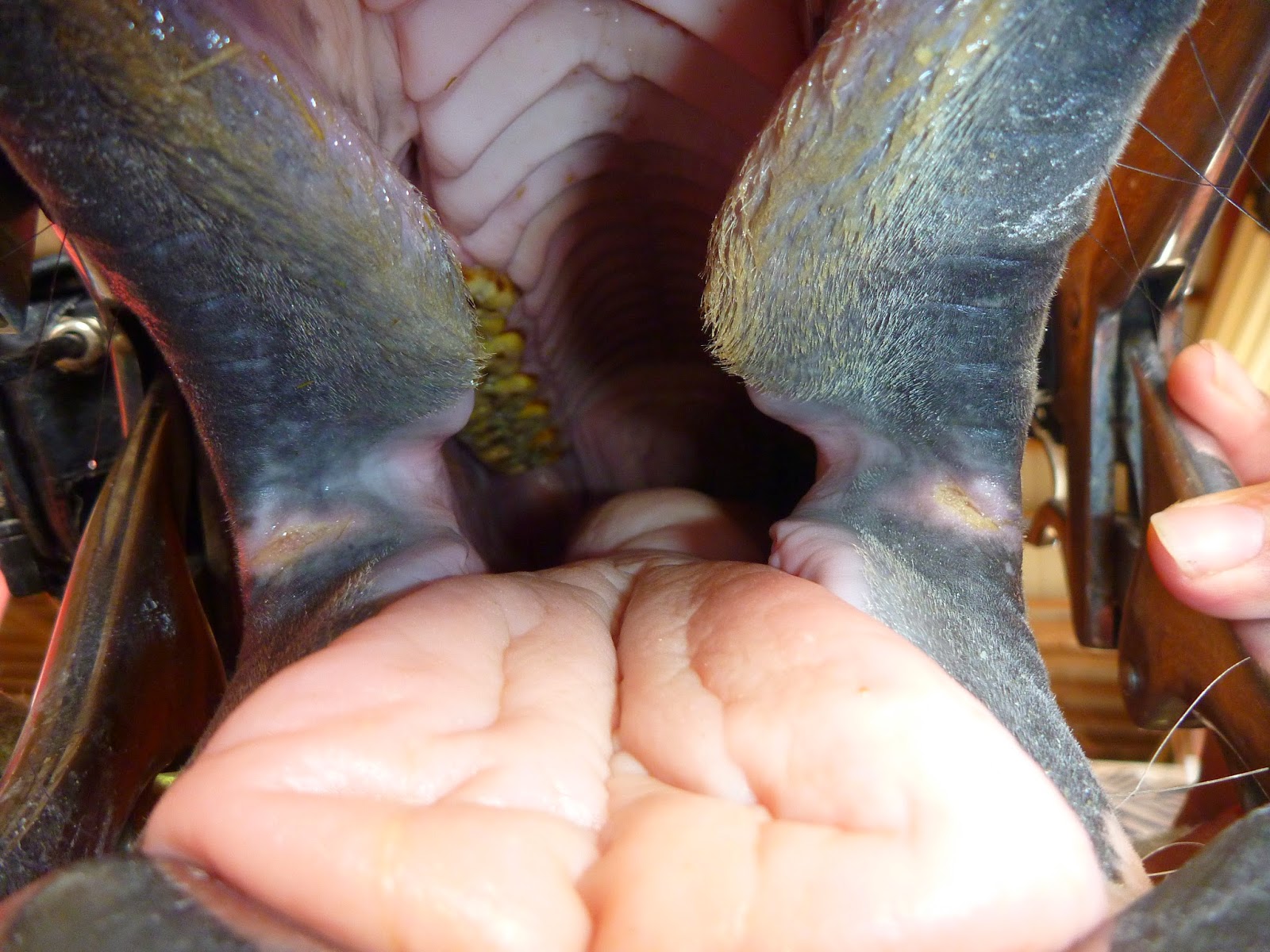

This bit is about an inch (at least) over a normal bit placement. A mouth piece should sit just in the mouth crease maybe a wrinkle, at the most a wrinkle and a half. Anytime the rider touches the reins the bit is going to engage an 1 to 2 inches further into the back molars. In addition to the straightness of the purchase and shank this horse is set up to really feel the slightest touch.
The loose ring on the mouthpiece provides a twisting pinch to the crease where his ulcers are.
I can see that the mouthpiece is twisted/grooved providing less surface area on the bars and tongue thus more responsive/more painful. (I like explain it by comparing a rail to a bench. The 2" rail having less contact on your rear is going to make your butt hurt a lot faster when you sit on it).
While I do not have a picture of just the bit I am 99% sure this is a dog bone mouthpiece which offers absolutely no tongue relief and slams on the bars, but cannot come into contact with the palate like a really straight snaffle/jointed mouthpiece.
And the tongue seems depressed where the mouthpiece would be in play when you study the 3rd picture.
The Solution:
Using a bigger bit (or using one in this way) is never a substitute for training. Ideally I would want to get this horse in another bit as quickly as possible and instead go back and reassess his training program to fix the holes in his stop and steering before racing him further.
But this horse's riding life could greatly be improved by lowering the bit to a normal position in the mouth and by adding bit guards to protect against pinching effect of the loose ring mouthpiece.
If you would like to submit your horse/bit for future analysis contact me here.
Our hope is to try to raise overall biting awareness. Showcasing how these bits are interacting with the mouth, hopefully help horses avoid common/chronic mouth problems caused by bits and their placement, and offer more humane biting options and solutions.
This is a 14 year old gelding primarily used for barrel racing.
This bit is about an inch (at least) over a normal bit placement. A mouth piece should sit just in the mouth crease maybe a wrinkle, at the most a wrinkle and a half. Anytime the rider touches the reins the bit is going to engage an 1 to 2 inches further into the back molars. In addition to the straightness of the purchase and shank this horse is set up to really feel the slightest touch.
The loose ring on the mouthpiece provides a twisting pinch to the crease where his ulcers are.
I can see that the mouthpiece is twisted/grooved providing less surface area on the bars and tongue thus more responsive/more painful. (I like explain it by comparing a rail to a bench. The 2" rail having less contact on your rear is going to make your butt hurt a lot faster when you sit on it).
While I do not have a picture of just the bit I am 99% sure this is a dog bone mouthpiece which offers absolutely no tongue relief and slams on the bars, but cannot come into contact with the palate like a really straight snaffle/jointed mouthpiece.
And the tongue seems depressed where the mouthpiece would be in play when you study the 3rd picture.
The Solution:
Using a bigger bit (or using one in this way) is never a substitute for training. Ideally I would want to get this horse in another bit as quickly as possible and instead go back and reassess his training program to fix the holes in his stop and steering before racing him further.
But this horse's riding life could greatly be improved by lowering the bit to a normal position in the mouth and by adding bit guards to protect against pinching effect of the loose ring mouthpiece.
If you would like to submit your horse/bit for future analysis contact me here.
Subscribe to:
Posts (Atom)