Showing posts with label floating teeth. Show all posts

Thursday, May 15, 2014

Bit Doctor- A In Depth Series Looking At Bits And How They Interact In The Horse's Mouth

Recently I have entered in to a educational partnership with The Texas Equine Dentist and will now from time to time be featuring bit analysis' from some of his cases.

Our hope is to try to raise overall biting awareness. Showcasing how these bits are interacting with the mouth, hopefully help horses avoid common/chronic mouth problems caused by bits and their placement, and offer more humane biting options and solutions.

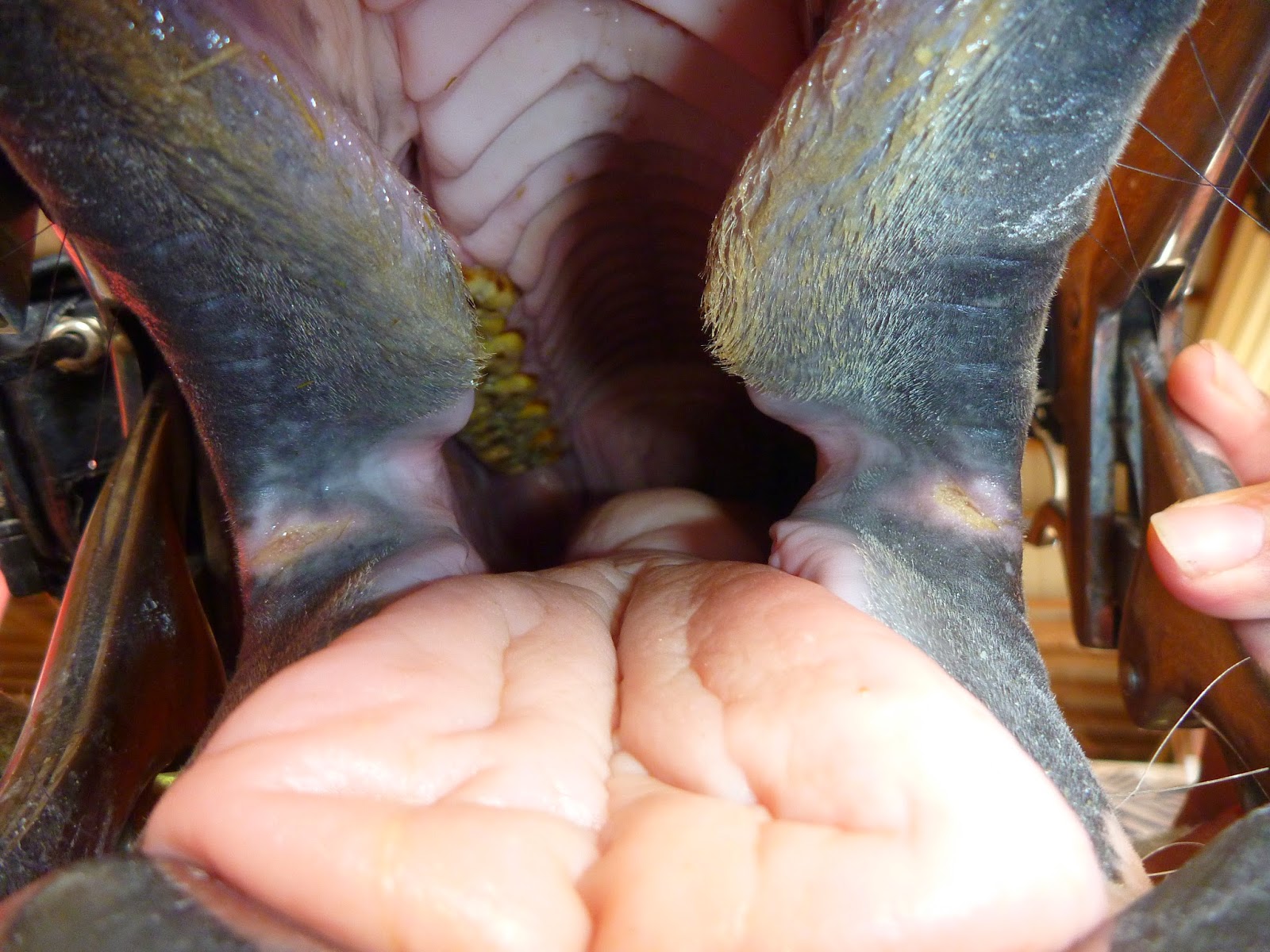
This is a 14 year old gelding primarily used for barrel racing.


This bit is about an inch (at least) over a normal bit placement.  A mouth piece should sit just in the mouth crease maybe a wrinkle, at the most a wrinkle and a half.  Anytime the rider touches the reins the bit is going to engage an 1 to 2 inches further into the back molars.  In addition to the straightness of the purchase and shank this horse is set up to really feel the slightest touch.    

The loose ring on the mouthpiece provides a twisting pinch to the crease where his ulcers are. 


I can see that the mouthpiece is twisted/grooved providing less surface area on the bars and tongue thus more responsive/more painful. (I like explain it by comparing a rail to a bench.  The 2" rail having less contact on your rear is going to make your butt hurt a lot faster when you sit on it). 

While I do not have a picture of just the bit I am 99% sure this is a dog bone mouthpiece which offers absolutely no tongue relief and slams on the bars, but cannot come into contact with the palate like a really straight snaffle/jointed mouthpiece.  

And the tongue seems depressed where the mouthpiece would be in play when you study the 3rd picture.  

The Solution:

Using a bigger bit (or using one in this way) is never a substitute for training. Ideally I would want to get this horse in another bit as quickly as possible and instead go back and reassess his training program to fix the holes in his stop and steering before racing him further.

But this horse's riding life could greatly be improved by lowering the bit to a normal position in the mouth and by adding bit guards to protect against pinching effect of the loose ring mouthpiece.

If you would like to submit your horse/bit for future analysis contact me here.
    

Friday, July 6, 2012

Bits and Bitting Part 2- Anatomy

What about bits? 

This is something that has always bothered me.  We worry about, discuss, and research; feeding, saddle fit, and hoof care and yet we are more than happy to shove any random piece of metal in our horse's mouth and ride around. 

Why are we willing to take someone else's word and recommendation without any understanding of what we are actually putting in our horses mouths?   It's time we start talking about bits, and the discussion starts right now.  

 
Egg Butt Snaffle- immobilizing tougue, clamping nutcracker effect on bars, mouth open in resistance 

Loose ring snaffle- pushing through soft pallet, nutcracker effect on bars


I did not just wake up one day and decide that I wanted to know everything possible about bits.  My father's lovely mare was the true inspiration and the beginning of my journey because no matter what bit you put her in mouth she would fuss/fiddle with it constantly. Which after trying every bit we in the barn lead my Mom and I to start looking for a solution, and what we found was a wealth of information and as a result some very happy horses. 


In order to begin to understand bits we must first understand a little basic anatomy. 


Artwork by Cathy Sullins
8yr old mare paint mare

It looks like you have plenty of room for any size bit until you get to the real life photo.  When taking this photo we were astonished at how much room the tougue actually takes up.

While all horses have the same structures (plus or minus wolf teeth) no two mouths are alike, and individual characterists can play huge role in finding the correct bit.  
 
Would both these horses do equally well in the same bit?


Probably not, the one on the right will require much more tougue relief than the horse on the left.

Factors to consider when choosing a bit-
1. Head shape- Generally the courser a horse's head and muzzle the meater the mouth and tougue, which calls for more tougue relief.
2. Age- A horse's mouth changes constantly throughout it's life. So the bit that works perfectly at age 5 may hurt by age 15.  Check out  http://rogueequine.com/services/dentistry/ for a great general write up on equine dentition.
3. Past History- Some horses may have permanent damage from previous bits causing them to not respond to certain types of pressure. 
4. General Dental Health- Young horses may be cutting teeth causing them to react negatively to certain bits at certian times or older horses may have loose or missing teeth.  


Is your young horse being naughty, maybe it's his teeth.
Common ages for tooth eruption.
Type of toothNumberDeciduousPermanent
IncisorFirst (central)birth to 8 days2.5 yrs
IncisorSecond (intermediate)4.5–6 weeks3.5–4 yrs
IncisorThird (corner)6–9 months4.5–5 yrs
CanineAbsent3.5–5 yrs, some around 6 yrs (if ever)
PremolarFirst (wolf)Absent6 months to 3 years (if ever)
PremolarSecondbirth to 2 weeks2–3 yrs
PremolarThirdbirth to 2 weeks2.5–3 yrs
PremolarFourthbirth to 2 weeks3–4 yrs
MolarFirstAbsent9–12 months
MolarSecondAbsent2 yrs
MolarThirdAbsent3–4 yrs


 Unlike hospital sock bits are not one size fits, and should be considered and fitted on a individual basis. 


Stay tuned for Part 3- Resistance