Showing posts with label curb bit. Show all posts

Wednesday, February 12, 2014

Personal observations- snaffle vs. curb in finished horse

My main mare Pie has been off for the better part of 3 years due to work, both our pregnancies, and now juggling work and a baby.

Starting in last month I have been able to focus on riding more so I will be posting some of my experiences.


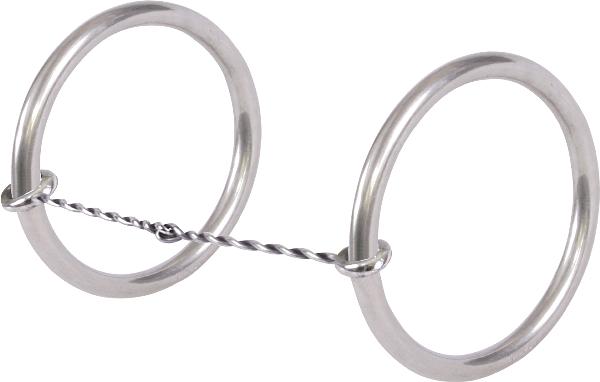
For the past few years I have ridden her in this.


Looking to brush off the cobwebs in her mid I decided to start back in this. 


I rode her twice in the snaffle and then put her back in her regular curb.

I have written quite a bit on bits and biting if you need a refresher.


Some of my observations:

There was a slight dullness in using the snaffle on Pie's advanced maneuvers compared to her usual curb. Without the leverage and angle of the shank to she did not have the "yellow light" to warn her that the bit was about to be engaged which made her less reactive/dull.  No having the "yellow light" warning the snaffle made me spend more time in her mouth.  

Her shoulder yields were less fluid in the jointed snaffle over the 3 piece mouthpiece of the curb.  The Jointed mouthpiece on the snaffle engaged both sides of her mouth vs the one side that is usually touched by the curb making for a less fluid movement.  

Having been ridden in a ported mouthpiece for so long Pie did not enjoy the lack of tongue relief she had in the snaffle, she chopped on the bit. 

In general I felt a lack of finesse taking Pie back down to a snaffle.   

Thoughts:

I feel that it is important to remember to view our bits as tools for communication.  

The anatomy of a simple jointed snaffle can make it harder for you to clearly communicate what you want your horse to do.  Especially when trying to do advanced maneuvers.  

Excessive bit play can be a call for tongue relief.

At the end of the day this experiment was a reminder that if your really want to achieve a super light bridle horse you may have to move up into a curb for some parts of your training or at least look further than a simple jointed mouthpiece.  

Of course no bit is a substitute for good training, timing and your release of pressure are what really determine how light and responsive your horse is but the right bit can aid in your horse's understanding and speed up the training process.  

Note:  All observations in the post were based on the experiences riding a very broke, light, and responsive horse.  The changes noted between the snaffle and curb were very minor but still enough to be noted.    


Friday, July 20, 2012

Bits and Bitting Part 4: The truth about snaffle bits

The Snaffle Bit.  

Every horse owner has one or has used one at one point in time, and it is widely (and blindly) accepted as the softest and most humane bit available.


In the book "A Whole Bit Better"  By Dale, Ron, and Bob Myler a snaffle is described as a ring bit, "The rings may be round, oval, or shaped like a "D."  A loose ring allows the mouthpiece to rotate around the ring; a fixed ring does not.  Both the headstall and the reins are attached to the ring.  When pressure is exerted through the reins, the bit pulls with the same amount of pressure backward on the horse's mouth; thus a ring bit is often called a direct action bit."

Simply put true snaffle bits are direct action, non leverage bits. 


Meaning that pound for pound your horse feels the exact amount of force you use.

A snaffle is only a snaffle when the mouthpiece, reins, and bridle are all attached to to the same ring. 

A snaffle bit may have any type of mouthpiece.


All of these bits are snaffle bits because the mouthpiece, bridle, and reins all attach to the same ring. 

 Just because a bit is called a snaffle does not mean that it is humane.


Direct Rein Bits work by contacting the palate, bars, tongue, and lips.


The mouthpiece and the amount of pressure used by the rider determines the severity of a snaffle or direct rein/action bit.

A straight mouthpiece can create a nutcracker effect on the tongue and bars.

While a more curved mouthpiece will not immobilize the tongue.

Which would you put in your own mouth?
                          1                                                                                                      2

3                                                              4

I have used 1, 3, and 4, based on each individual horse's preferences, but never number 2.


In closing a snaffle is a direct rein bit.  

A snaffle is only a snaffle if the mouthpiece, bridle, and reins are attached on the same ring.

The severity of a snaffle bit is determined by it's fit, construction, and amount of tongue relief provided. 

A straight bar mouthpiece like number 2 (disregard the twist, looking only at the straightness of the mouthpiece) is more severe 1, 3, and 4. 

Bit number 3 is more severe than bits 1 and 4 due to the amount of tongue relief available.

A twisted mouthpiece is more severe than a smooth mouthpiece.

A smooth twisted mouthpiece is less severe than a square, or fishback twisted mouthpiece. 

The thinner the mouthpiece the more severe.


Stay tuned for Curb/Leverage Bits coming soon.  


Friday, July 13, 2012

Bits and Bitting Part 3- Resistance- The root of all bits

 Resistance- the refusal to accept or comply with something; the attempt to prevent something by action or argument.

A few common examples of resistance in horses:   

Getting behind the bit
Inversion
Running through the bit
Dropping the shoulder
High or tossing head
Gaping or busy mouth
Unyielding neck
Tipping the nose to the outside
Pushing out against the reins 


Resistance is direct result of:
Pain
Fear
or
Lack of Training

Now you must be asking yourself why I'm talking about resistance in the middle of a biting discussion, because we as riders often use bits to fix resistance, and that the more resistant a horse is the harsher is bit that should be used. 

(yes that is a bike chain bit, these are from our evil bit collection)

Bits can create resistance through poor fit, pain (from the bit or from needing dental work), fear,and lack of training.


Good bits can wear out and cause resistance.

Damaged medium twist copper half cheek snaffle

Bottomline:
Pain, poor fit, and lack of training create resistance undersaddle, and a harsher bit should only be used after all other aspects have been explored. 

A bit is never a subsutite for training.

Stay tuned for snaffle bits!


Friday, July 6, 2012

Bits and Bitting Part 2- Anatomy

What about bits? 

This is something that has always bothered me.  We worry about, discuss, and research; feeding, saddle fit, and hoof care and yet we are more than happy to shove any random piece of metal in our horse's mouth and ride around. 

Why are we willing to take someone else's word and recommendation without any understanding of what we are actually putting in our horses mouths?   It's time we start talking about bits, and the discussion starts right now.  

 
Egg Butt Snaffle- immobilizing tougue, clamping nutcracker effect on bars, mouth open in resistance 

Loose ring snaffle- pushing through soft pallet, nutcracker effect on bars


I did not just wake up one day and decide that I wanted to know everything possible about bits.  My father's lovely mare was the true inspiration and the beginning of my journey because no matter what bit you put her in mouth she would fuss/fiddle with it constantly. Which after trying every bit we in the barn lead my Mom and I to start looking for a solution, and what we found was a wealth of information and as a result some very happy horses. 


In order to begin to understand bits we must first understand a little basic anatomy. 


Artwork by Cathy Sullins
8yr old mare paint mare

It looks like you have plenty of room for any size bit until you get to the real life photo.  When taking this photo we were astonished at how much room the tougue actually takes up.

While all horses have the same structures (plus or minus wolf teeth) no two mouths are alike, and individual characterists can play huge role in finding the correct bit.  
 
Would both these horses do equally well in the same bit?


Probably not, the one on the right will require much more tougue relief than the horse on the left.

Factors to consider when choosing a bit-
1. Head shape- Generally the courser a horse's head and muzzle the meater the mouth and tougue, which calls for more tougue relief.
2. Age- A horse's mouth changes constantly throughout it's life. So the bit that works perfectly at age 5 may hurt by age 15.  Check out  http://rogueequine.com/services/dentistry/ for a great general write up on equine dentition.
3. Past History- Some horses may have permanent damage from previous bits causing them to not respond to certain types of pressure. 
4. General Dental Health- Young horses may be cutting teeth causing them to react negatively to certain bits at certian times or older horses may have loose or missing teeth.  


Is your young horse being naughty, maybe it's his teeth.
Common ages for tooth eruption.
Type of toothNumberDeciduousPermanent
IncisorFirst (central)birth to 8 days2.5 yrs
IncisorSecond (intermediate)4.5–6 weeks3.5–4 yrs
IncisorThird (corner)6–9 months4.5–5 yrs
CanineAbsent3.5–5 yrs, some around 6 yrs (if ever)
PremolarFirst (wolf)Absent6 months to 3 years (if ever)
PremolarSecondbirth to 2 weeks2–3 yrs
PremolarThirdbirth to 2 weeks2.5–3 yrs
PremolarFourthbirth to 2 weeks3–4 yrs
MolarFirstAbsent9–12 months
MolarSecondAbsent2 yrs
MolarThirdAbsent3–4 yrs


 Unlike hospital sock bits are not one size fits, and should be considered and fitted on a individual basis. 


Stay tuned for Part 3- Resistance


Monday, July 2, 2012

Bits and Bitting Part 1- One of these pictures is not like the others

For the last few years my Mother and I have done a biting presentation as a part of many of our clinics.  This month I will adapting our presentation into multiple blog posts. Today we start by gaining some perspective about how bits affect our horses.


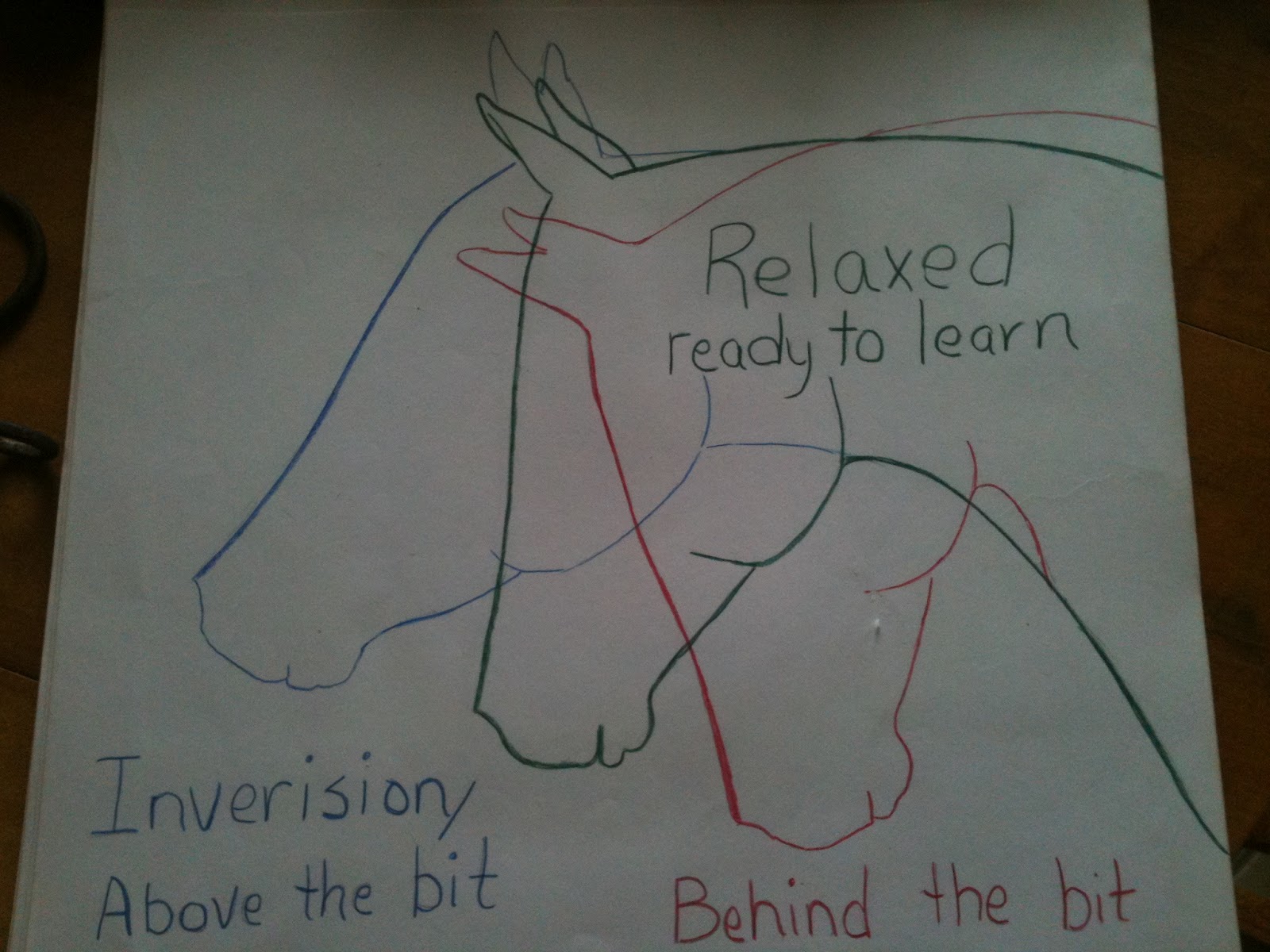
At first glance what do you think this horse is thinking?


now


What do you think this horse is thinking?


now


What do you think this horse is thinking?


Answers:

Horse 1: "OMG! THERE IS A LION ON MY BACK, I'M GONNA DIE!"

Horse 2: "OMG! I CAN'T ESCAPE THIS BIT, I CAN NEVER ESCAPE THIS BIT!  WHAT DID I DO TO DESERVE THIS!"

Horse 3:  "Oh boy, What are we going to do today?"


Which horse do you think is focused in a positive way on his rider and is willing and ready to try and learn?


Stay tuned for tomorrow's post where we follow up by talking about bits in general and signs of resistance.


My tack collection obession explained


My trailer bridle rack, holding some of my favorite tools.


 My tack collection obession explained.   

I get it honest.  You see I grew up in a tackaholic horsehold.  Much as other women collect and cherish jewelry or shoes, my Mom was and still is all about bits and leather.  Growing up with her (a skilled amateur trainer) I was always taught to use the right tool for the job, and that the right tool may be different for each horse so it is important to have options.  So I grew up with a tackroom filled with bits and bridles of every kind imaginable with all being useful and important in some form or fashion.  Some pieces were there because she wanted to study them further, others because she wanted to try them, some were there because they were great and just not needed at the time, and others still were there simply because they should never be used again (abusive/inhumane bits, we collect them to educate people and to keep them away from horses).

Simply put every piece in both our collections has been collected with care and consideration.  So the next time you think our tack rooms or trailers are cluttered just remember that for some horsepeople every piece has a purpose.

P.S. - Thanks Mom you did raise me right.  (I think she has finally figured out how to access this thing)