We all want a light and responsive horse. We want a horse that reins with minimal contact. One that instantly responds to the lightest cue. We want a horse that moves off our leg instead of plowing into it. We want a horse that doesn't pull, wobble, or resist.
We all know what we want but few know how to actually achieve it.
Lightness comes from letting go... over and over and over and over again.
In order to teach a horse lightness a rider must be willing to cue their horse for what they want and back up what they say. This means a rider must first ask for a response and then back up their request by making their horse do as requested (this means increasing the leg, rein, or other pressure until the horse responds appropriately). Once the horse has properly responded to the cue the rider must then release and be willing to do it all over again.
In order to teach lightness a rider must be willing to repeat the above process until the horse responds to the cue the moment that it is used.
Teaching lightness takes time and constancy. The rider must be willing to back up every cue that they use and release the moment that the horse responds to their satisfaction.
So to achieve lightness a rider must be willing to 'check' their horse constantly.
Anytime the horse pulls to the outside of a circle, or lays into a rider's legs a rider must be willing to cue to horse to the proper response and immediately release once again.
This means that in the beginning of teaching lightness a rider may have to check their horse 10 or 15 times in a single working circle, or a few times for every simple turn.
Teaching lightness takes a "do it right every time, all the time" mentality on the part of the rider.
I will continue on this topic in my next post.
Showing posts with label dressage. Show all posts
Showing posts with label dressage. Show all posts
Monday, February 25, 2013

Friday, December 21, 2012
Through the eyes of a trainer (why we need horse trainers)
In this modern age the average horse person has access to a wealth of information. From magazines to books to online videos and dvds you can learn just about anything. This near limitless amount of information has gone a long way in helping everyday horse owners improve their skills and general horsemanship, but there are still some things that cannot be learned without the guidance of a skilled trainer.
I like to say that horse training is both an art and an science because unlike baking a cake you cannot just follow the directions and measurements on the package and have everything turn out perfect. Training a horse requires timing and for lack of a better word feel both of which involve constantly changing variables.
When I start a horse (I hate using the word "break") I follow a basic formula, meaning that I know what I need to do at each stage to achieve the next. I know where my horse needs to be with one skill/behavior in order to successfully move on to another. This is the type of information found in every magazine article, book, and dvd. These media sources tell you the steps you need achieve your results but they only share the big picture.
Beyond the basic formula my training takes on art like form where I am constantly using feel and personal intuition in addition to timing to achieve the results I desire. I know that every single horse I ride requires a slightly different approach. With feel and intuition I am able to determine how much each horse needs to give and do on any given day to be successful. Where Horse A may be mentally able to learn how to yield his hindquarter and his forequarter in one day, Horse B may only be ready to yield his hindquarter a single step. This doesn't mean that Horse B will never achieve the level of Horse A it just means that a single step was all that Horse B could handle that day. Tomorrow Horse B having been given time to think may surpass Horse A on the next lesson. I train by reading how my horse feels and by learning how he thinks. Using my sense of timing I release and reward according to the individual and how he is performing each maneuver on any given day.
The problem with intuition, feel, and timing is that their only constant is that they are constantly changing. You may start at one level of timing at the beginning of the ride and finish in a completely different place. You have to know when you need to go back to zero and when you are ready to zoom up to sixty and this can fluctuate back and forth in a matter of minutes and at times even seconds.
Only through experience, trail and error, and guidance by someone skilled in the art of training are you able to develop a true sense of feel. While it is theoretically possible to achieve these skills without outside help working with someone is the fastest and most painless way to achieve your training goals. Remember that every great professional rider has or has had a great mentor. Greatness is rarely achieved alone.
I like to say that horse training is both an art and an science because unlike baking a cake you cannot just follow the directions and measurements on the package and have everything turn out perfect. Training a horse requires timing and for lack of a better word feel both of which involve constantly changing variables.
When I start a horse (I hate using the word "break") I follow a basic formula, meaning that I know what I need to do at each stage to achieve the next. I know where my horse needs to be with one skill/behavior in order to successfully move on to another. This is the type of information found in every magazine article, book, and dvd. These media sources tell you the steps you need achieve your results but they only share the big picture.
Beyond the basic formula my training takes on art like form where I am constantly using feel and personal intuition in addition to timing to achieve the results I desire. I know that every single horse I ride requires a slightly different approach. With feel and intuition I am able to determine how much each horse needs to give and do on any given day to be successful. Where Horse A may be mentally able to learn how to yield his hindquarter and his forequarter in one day, Horse B may only be ready to yield his hindquarter a single step. This doesn't mean that Horse B will never achieve the level of Horse A it just means that a single step was all that Horse B could handle that day. Tomorrow Horse B having been given time to think may surpass Horse A on the next lesson. I train by reading how my horse feels and by learning how he thinks. Using my sense of timing I release and reward according to the individual and how he is performing each maneuver on any given day.
The problem with intuition, feel, and timing is that their only constant is that they are constantly changing. You may start at one level of timing at the beginning of the ride and finish in a completely different place. You have to know when you need to go back to zero and when you are ready to zoom up to sixty and this can fluctuate back and forth in a matter of minutes and at times even seconds.
Only through experience, trail and error, and guidance by someone skilled in the art of training are you able to develop a true sense of feel. While it is theoretically possible to achieve these skills without outside help working with someone is the fastest and most painless way to achieve your training goals. Remember that every great professional rider has or has had a great mentor. Greatness is rarely achieved alone.
Sunday, October 28, 2012
Riding tips, tricks, and words of wisdom
Many of you may have hear these from myself or other people, but here is a list of tips and tricks off the top of my head.
Tips for under saddle:
1. If you are having a hard time picking up a lead try asking in a smaller circle. The smaller the circle (small not tiny) the easier it is on your horse to lope/canter in the correct lead.
2. If you are having trouble picking up a counter-canter work in a bigger circle and slowly scale down the size as your horse gets comfortable.
3. Large wide circles encourage your horse to speed up (think reining) while smaller circles encourage your horse to slow down. This works at both a trot and lope.
4. The more you move the faster your horse will move, think posting verses sitting a trot.
5. Your horse's mind is where ever his nose is. If he is hanging his nose to the outside of your circle he is not focused with or on you.
6. If you can see your horse's inside eye/eyelashes or the buckle of your bridle your horse's shoulders are upright or close to it when working in a circle.
7. When trying to lift your horse's shoulders you must first lift your hand before moving it over. If you just move your hand over you will only tilt your horses head instead of lifting the shoulder.
8. When your horse warping your circles to the outside. Brace with your outside leg (leg facing to the outside of the circle) and direct with your inside rein.
9. When your horse is cutting off your circles to the inside brace with your inside leg (leg facing to the inside of the circle you are riding) and lift your inside rein up and over to lift the shoulder and widen your circle.
10. It is much easier long term to correct a bad behavior the moment it happens (yes this applies to a horse who normally doesn't do that) than to allow it to get out of hand. Even the most well trained horse will try and push their boundaries at some time or the other.
11. If they do it once they will do it again. This applies to warping circles, dropping shoulders, walking off while mounting, and everything in between. It is your job as the rider to recognize patterns in your horses behavior and work to fix them.
12. All of a sudden does not exist in the horse world. Your horse told you he was upset (high head, braced neck, distracted, tense) and you did not listen. 99% of all spooks can be avoided by paying attention to your horse.
13. When in doubt move his feet. It very hard to spook, buck, and or rear when all four feet are already moving.
14. It is not the pressure that teaches but the release of pressure.
15. When the going gets tough break everything down into tiny little steps and reward any progress in the right direction.
16. If you want your horse to always do something you must always be willing to make them do it.
17. Always make the right behaviors easy and the wrong behaviors hard.
18. When you teach your horse to move forward without constant kicking, kissing, and general encouragement you are then able to use your legs to cue other maneuvers, you will also be a lot less tired after riding.
19. If you want your horse to learn to do something for themselves (moving forward, traveling with up right shoulders, etc) you must be willing to let go. You must be willing to let them try and mess up over and over again.
20. Riding a horse is a lot like driving a car. You are very likely to crash and burn when you take your hands off the wheel and stop paying attention.
Tips for under saddle:
1. If you are having a hard time picking up a lead try asking in a smaller circle. The smaller the circle (small not tiny) the easier it is on your horse to lope/canter in the correct lead.
2. If you are having trouble picking up a counter-canter work in a bigger circle and slowly scale down the size as your horse gets comfortable.
3. Large wide circles encourage your horse to speed up (think reining) while smaller circles encourage your horse to slow down. This works at both a trot and lope.
4. The more you move the faster your horse will move, think posting verses sitting a trot.
5. Your horse's mind is where ever his nose is. If he is hanging his nose to the outside of your circle he is not focused with or on you.
6. If you can see your horse's inside eye/eyelashes or the buckle of your bridle your horse's shoulders are upright or close to it when working in a circle.
7. When trying to lift your horse's shoulders you must first lift your hand before moving it over. If you just move your hand over you will only tilt your horses head instead of lifting the shoulder.
8. When your horse warping your circles to the outside. Brace with your outside leg (leg facing to the outside of the circle) and direct with your inside rein.
9. When your horse is cutting off your circles to the inside brace with your inside leg (leg facing to the inside of the circle you are riding) and lift your inside rein up and over to lift the shoulder and widen your circle.
10. It is much easier long term to correct a bad behavior the moment it happens (yes this applies to a horse who normally doesn't do that) than to allow it to get out of hand. Even the most well trained horse will try and push their boundaries at some time or the other.
11. If they do it once they will do it again. This applies to warping circles, dropping shoulders, walking off while mounting, and everything in between. It is your job as the rider to recognize patterns in your horses behavior and work to fix them.
12. All of a sudden does not exist in the horse world. Your horse told you he was upset (high head, braced neck, distracted, tense) and you did not listen. 99% of all spooks can be avoided by paying attention to your horse.
13. When in doubt move his feet. It very hard to spook, buck, and or rear when all four feet are already moving.
14. It is not the pressure that teaches but the release of pressure.
15. When the going gets tough break everything down into tiny little steps and reward any progress in the right direction.
16. If you want your horse to always do something you must always be willing to make them do it.
17. Always make the right behaviors easy and the wrong behaviors hard.
18. When you teach your horse to move forward without constant kicking, kissing, and general encouragement you are then able to use your legs to cue other maneuvers, you will also be a lot less tired after riding.
19. If you want your horse to learn to do something for themselves (moving forward, traveling with up right shoulders, etc) you must be willing to let go. You must be willing to let them try and mess up over and over again.
20. Riding a horse is a lot like driving a car. You are very likely to crash and burn when you take your hands off the wheel and stop paying attention.
Wednesday, August 22, 2012
Dressage gets The Colbert Bump
A wonderful thing happened recently in the horse world. Thanks to The Colbert Report and Stephen Colbert with the help of Michael Barisone
millions of people have been introduced to the sport of dressage and the world of horses.
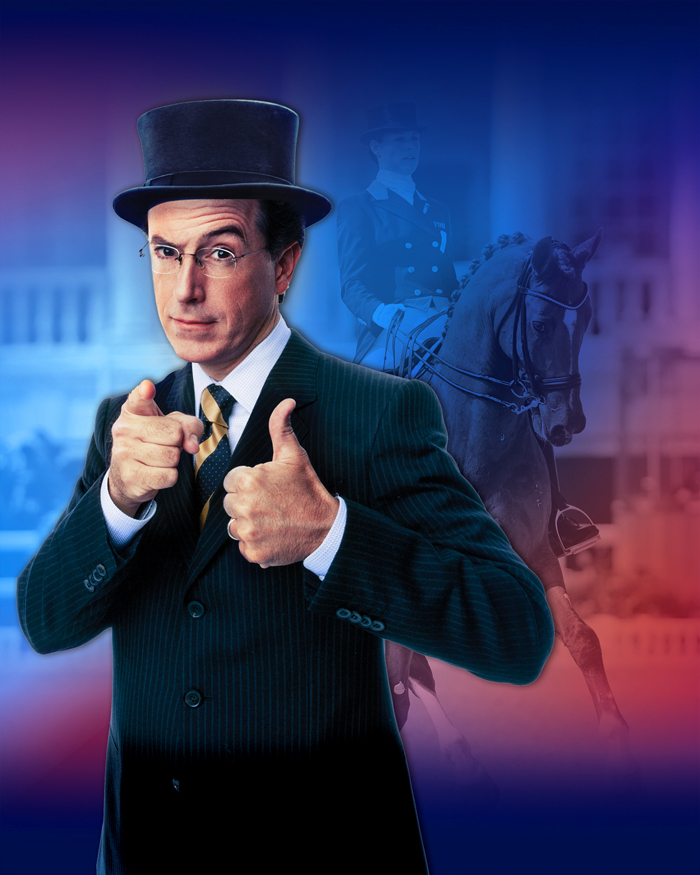
Be prepared to laugh, I know I sure did; and be sure to share it with all your horsey and non friends.
Image from The Chronicle of the Horse
Stephen's Dressage Training Pt. 1
Stephen's Dressage Training Pt. 2
And for a behind the scenes look check out this from The Chronicle of the Horse.
Monday, July 16, 2012
Keeping a good horse honest
Yesterday my friend came by to deliver a chicken (long story) and while we were outside talking near the horses Charlie immediately came up and offered to join the conversation while Pie (unlike her normal self) choose to stay back and did not offer to come forward. Busy enjoying the conversation I put her odd behavior out of mind until walking back from closing the front gate.
You see Pie is a attention hound, and she loves people. She will drive you crazy with "moral support" when working outside, and she actually asks to be caught. Needless to say I found her indifference troubling.
Then I realized that Pie had never seen my friend or her car before and had assumed that I was about to give a riding lesson. She has to do it time to time and when Charlie was recovering last fall and winter she had to take over his riders all of whom were beginners, and she does not enjoy teaching beginner adult riders.
Pie likes a skilled rider or someone small enough (kid) that they do not bother her with their aids. She likes a confident rider with a decent seat, someone who understands and uses leg cues, and someone who works with her instead of holding her back.
Charlie on the other hand seems to really enjoy giving beginner lessons. A former ranch horse in the states of Montana and Wyoming, he appreciates a rider who only wants to walk and trot if that. In a soft as butter bit and good fitting saddle he doesn't mind gripped knees, and heavy hands. He loves the attention though, he soaks it up like a sponge.
So what does any of this have to do with keeping a good horse honest?
A good horse must enjoy their job to stay honest.
Any horse repeatedly put into situations they do not like will start to act out. Pie put into a busy beginner lesson program would probably turn into a very bad horse very quickly.
Now does this mean that because Pie hates beginner lessons she will never have to give one again?
No, If I need her to she can and will give a great beginner lesson. But knowing that she hates it and in the interest of keeping her happy and honest long term I will not ask her to give one unless absolutely necessary. I would much rather have a happy horse ridden by a few than a super pissed horse ridden by many.
Long story short, in order for a horse to remain good and honest they must like the work that they do. A unhappy horse will act out and possibly become dangerous over time. Negative changes in behavior, personality, and habits when trying new sports/situations may mean that your horse does not like what you are doing. While this does not mean that a horse should be exempt from anything they do not like. A horse will never excel when forced and unhappy.
Happy Horse = Good and Honest Horse
You see Pie is a attention hound, and she loves people. She will drive you crazy with "moral support" when working outside, and she actually asks to be caught. Needless to say I found her indifference troubling.
Then I realized that Pie had never seen my friend or her car before and had assumed that I was about to give a riding lesson. She has to do it time to time and when Charlie was recovering last fall and winter she had to take over his riders all of whom were beginners, and she does not enjoy teaching beginner adult riders.
Pie likes a skilled rider or someone small enough (kid) that they do not bother her with their aids. She likes a confident rider with a decent seat, someone who understands and uses leg cues, and someone who works with her instead of holding her back.
Charlie on the other hand seems to really enjoy giving beginner lessons. A former ranch horse in the states of Montana and Wyoming, he appreciates a rider who only wants to walk and trot if that. In a soft as butter bit and good fitting saddle he doesn't mind gripped knees, and heavy hands. He loves the attention though, he soaks it up like a sponge.
So what does any of this have to do with keeping a good horse honest?
A good horse must enjoy their job to stay honest.
Any horse repeatedly put into situations they do not like will start to act out. Pie put into a busy beginner lesson program would probably turn into a very bad horse very quickly.
Now does this mean that because Pie hates beginner lessons she will never have to give one again?
No, If I need her to she can and will give a great beginner lesson. But knowing that she hates it and in the interest of keeping her happy and honest long term I will not ask her to give one unless absolutely necessary. I would much rather have a happy horse ridden by a few than a super pissed horse ridden by many.
Long story short, in order for a horse to remain good and honest they must like the work that they do. A unhappy horse will act out and possibly become dangerous over time. Negative changes in behavior, personality, and habits when trying new sports/situations may mean that your horse does not like what you are doing. While this does not mean that a horse should be exempt from anything they do not like. A horse will never excel when forced and unhappy.
Happy Horse = Good and Honest Horse
Monday, July 2, 2012
Bits and Bitting Part 1- One of these pictures is not like the others
For the last few years my Mother and I have done a biting presentation as a part of many of our clinics. This month I will adapting our presentation into multiple blog posts. Today we start by gaining some perspective about how bits affect our horses.

At first glance what do you think this horse is thinking?
now

What do you think this horse is thinking?
now

What do you think this horse is thinking?
Answers:
Horse 1: "OMG! THERE IS A LION ON MY BACK, I'M GONNA DIE!"
Horse 2: "OMG! I CAN'T ESCAPE THIS BIT, I CAN NEVER ESCAPE THIS BIT! WHAT DID I DO TO DESERVE THIS!"
Horse 3: "Oh boy, What are we going to do today?"
Which horse do you think is focused in a positive way on his rider and is willing and ready to try and learn?
Stay tuned for tomorrow's post where we follow up by talking about bits in general and signs of resistance.
My tack collection obession explained

My trailer bridle rack, holding some of my favorite tools.
My tack collection obession explained.
I get it honest. You see I grew up in a tackaholic horsehold. Much as other women collect and cherish jewelry or shoes, my Mom was and still is all about bits and leather. Growing up with her (a skilled amateur trainer) I was always taught to use the right tool for the job, and that the right tool may be different for each horse so it is important to have options. So I grew up with a tackroom filled with bits and bridles of every kind imaginable with all being useful and important in some form or fashion. Some pieces were there because she wanted to study them further, others because she wanted to try them, some were there because they were great and just not needed at the time, and others still were there simply because they should never be used again (abusive/inhumane bits, we collect them to educate people and to keep them away from horses).
Simply put every piece in both our collections has been collected with care and consideration. So the next time you think our tack rooms or trailers are cluttered just remember that for some horsepeople every piece has a purpose.
P.S. - Thanks Mom you did raise me right. (I think she has finally figured out how to access this thing)
Friday, January 13, 2012
Equine Definitions
Today I've decided to compile a list of unofficial horse definitions. It's funny what can pop into your head at 5am.
Trailer Trasher- A horse who trashes the walls, floor, and possibly even ceiling of the trailer with muck and urine.
Egging/Egged- When you are riding and your horse warps your circle an a certain direction, usually towards the barn, gate, or other horses. Use: Your horse is egging your circle every time you pass the gate.
Green- A inexperienced horse or rider.
Green Squared- A inexperienced horse and rider working together.
Stall Trasher- Same as Trailer Trailer but in a stall.
Barn Sour- Any horse who throws a fit about being ridden out away from the barn.
Buddy Sour- Any horse who throws a fit when separated from their horsey friends.
Fear Rider- Any person overcoming their fear of riding.
Turkey- A term of endearment. To be substituted for a name when you are super pissed at your horse. Especially useful when children and people you should not curse around are present.
Pumpkin- A term of endearment. To be substituted for a horse's name when you do not know their name, or you are a pleased with their progress or behavior.
Expressive- A nice way to say your horse is a bitch.
Opinionated- Another nice way to your horse is a pain in the back side.
Discussion- What happens when a horse acts out in a such a negative/dangerous way that requires correction. As in, "Today Red and I had a discussion about rearing."
Riding- The art of keeping a horse between you and the ground. (not mine but still funny)
Added Definitions
Dressage-The art of riding.
Communication- What happens when a rider listens to their horse.
Team- The bond that results from hours and hours of communication.
Can't- The frame of mind that prevents horses or riders from achieving success.
Training- What happens from the moment you step foot in the barn until moment you leave.
All of a sudden- What happens when you are not paying attention.
Guest Definitions
Cassandra Was Right
"Bombproof" - an adjective used to describe a horse that cannot be startled or surprised by anything - until the day that a lost party balloon a quarter mile away causes it to perform a 400-foot-record lateral quantum displacement.
Please feel free to add new ones by commenting and I will add them to the list.
Trailer Trasher- A horse who trashes the walls, floor, and possibly even ceiling of the trailer with muck and urine.
Egging/Egged- When you are riding and your horse warps your circle an a certain direction, usually towards the barn, gate, or other horses. Use: Your horse is egging your circle every time you pass the gate.
Green- A inexperienced horse or rider.
Green Squared- A inexperienced horse and rider working together.
Stall Trasher- Same as Trailer Trailer but in a stall.
Barn Sour- Any horse who throws a fit about being ridden out away from the barn.
Buddy Sour- Any horse who throws a fit when separated from their horsey friends.
Fear Rider- Any person overcoming their fear of riding.
Turkey- A term of endearment. To be substituted for a name when you are super pissed at your horse. Especially useful when children and people you should not curse around are present.
Pumpkin- A term of endearment. To be substituted for a horse's name when you do not know their name, or you are a pleased with their progress or behavior.
Expressive- A nice way to say your horse is a bitch.
Opinionated- Another nice way to your horse is a pain in the back side.
Discussion- What happens when a horse acts out in a such a negative/dangerous way that requires correction. As in, "Today Red and I had a discussion about rearing."
Riding- The art of keeping a horse between you and the ground. (not mine but still funny)
Added Definitions
Dressage-The art of riding.
Communication- What happens when a rider listens to their horse.
Team- The bond that results from hours and hours of communication.
Can't- The frame of mind that prevents horses or riders from achieving success.
Training- What happens from the moment you step foot in the barn until moment you leave.
All of a sudden- What happens when you are not paying attention.
Guest Definitions
Cassandra Was Right
"Special" - a truly and genuinely stupid horse. As in, "We need to give Ringo a little more time to figure out how to get through an open gate. Remember, he's special.""Lateral quantum displacement" - when a startled horse shifts position at least ten feet sideways in less than a nanosecond, leaving the rider suspended in midair.
"Bombproof" - an adjective used to describe a horse that cannot be startled or surprised by anything - until the day that a lost party balloon a quarter mile away causes it to perform a 400-foot-record lateral quantum displacement.
Please feel free to add new ones by commenting and I will add them to the list.
Subscribe to:
Posts (Atom)