Headsets, people love them.
There are few things prettier than a horse with a nice level headset. (Headset meaning- relaxed, light, not too high, not too low, and on and nearly on the vertical with little to no rein interference.)
While everyone wants an attractive headset many people rush through the training process and try to teach/achieve a nice headset before a horse is ready. In order to be ready for headsets and other more advanced maneuvers a horse must first have a firm grasp on the basics.
In order to achieve or school on a headset a horse must first-
* Have forward movement. A horse must first be moving freely and willingly under saddle with little to know encouragement from the rider.
* Be under complete control of the rider and light and responsive to all aids. A horse should not warp circles, veer off a straight line, or resist rein or leg pressure.
* Be able to rate. A horse must be able to maintain a constant speed at all gates as directed by the rider and do so on a loose rein.
Only after all of the above is achieved should a rider even consider schooling more advanced maneuvers. And a rider must also be willing to go back to the basics and do a little tuneup at any time before continuing in training.
Showing posts with label training. Show all posts
Showing posts with label training. Show all posts
Saturday, July 20, 2013

Saturday, February 16, 2013
The Feeding Commandments Part 2
The Feeding Commandments
Last post I laid out the 11 feeding commandments that are followed in the KnP household and I promised today's post will break down all the different commandments and how they are taught and reinforced.
I should start by saying that I teach these feeding rules to every horse that gets introduced into my herd. I use feeding time as yet another means establishing respect and control. Since horses establish herd dominance by who can move the other's feet (click the link to see what I'm talking about) and by controlling the food supply I have found that I can use feeding time to establish my place as "boss mare". And the more I am seen as the herd leader the more respectful and considerate my horses will be while I am on the ground and the better my rides will be under saddle.
I rarely have to spend more than a few days teaching a new horse the rules of feeding and after being taught I rarely have them challenged. Of course I generally do not have more than one horse at a time that does not know the rules and having other horses who know the drill so the speak can really help in the training process. For the average horse owner with several horses in need of training I recommend starting to teach these rules with a single horse and adding additional horses in a timely manner rather than starting out with the whole unruly bunch, but the process of teaching one horse is the same as teaching the whole herd at once which can be done.
1. The person feeding must be allowed to complete the task at their leisure.- When I say leisure I mean that you should be able to stop to tie your shoe and smell the roses without any horse hassling you and getting in your space. I teach this by carrying a whip with me every time I feed until the horse(s) have been respectful for several days. The more aggressive and pushy the horse(s) are the father away they have to stay from me at all times. I correct the slightest space infringement by charging (just like a boss mare) and "kicking" them with my whip (since I cannot kick like them for real I use my whip instead of hind legs to make contact when possible). I like to start with a 15ft-20ft respect circle and as the horse(s) learn to automatically keep that distance I will adjust it accordingly.
Only when all horses are a respectful distance do I proceed to dump the feed and move on. Be prepared to spend quite a while outside working on this. If you have limited time to feed start the training process on the weekend when you have time to spend working on it, and if need be you can divide up feedings and spend the greater part of a day working on establishing this respect. In my experience you may have to spend nearly an hour working on this the first time but after the initial lesson the time spent should greatly decrease to just a few minutes in just 2-4 feedings and no time at all when you are finished.
2. All horses must maintain a safe and respectful distance in relation to the person feeding and will be corrected accordingly.- Rule number 2 goes hand in hand with rule number 1 and is achieved in the same manner. I correct all personal space infringements with my body language and whip. Only after the horse(s) has settled down and is not actively trying to get in to my space do I proceed forward. I do not move forward or present feed until all horses are behaving in an appropriate manner. By an appropriate manner I mean waiting a respectful distance away facing towards me with their ears and body language in a passive and non aggressive manner.
3. No bullying or aggressive behavior will be allowed towards the person feeding or the other horses.- Any horse that tries to bully another horse while I am in the pasture will be corrected. I am the "boss mare" and when I am in the pasture no horse play will be allowed. I correct the offending horse by pushing them around with my body language and whip. At times I will feed the horse that was bullied and keep the offending horse away until they have given up trying steal the others feed before offering feed to the want to be bully. (Again I am generally teaching one horse at a time in a group that already knows the rules)
4. Feed will not be offered in general until all horses have settled down and are at or near their respective feeding stations.- I may change the feeding ordered at times (I usually feed in the order of the herd from the top horse down to the bottom) but I do not change their feeding stations. No horse will be fed at the wrong station so until they decide to go to the right place they will not be fed. Using this method 99% of the time after the feeding commandments have been established all horses will go to their respective places and wait their turn.
5. Feed will not be offered until the individual horse has settled down and is at their respective feeding station.- Same as number 4, each horse is only allowed to eat at their station. If they hassle me at the other feeding stations they will be kept off again using my whip and body language and only after they submit and go to the right place will they be given their feed. (The horse being protected tends to quickly figure out that they are "safe" and will generally happily allow you to keep the other horse off for them)
6. No horse is allowed to change stations or steal from the other horses until the person feeding has completely left the area.- Especially when dealing with two or more horses the top horse in the herd will try and steal from other horses. I correct this by keeping them off as in rule number 5. I will only leave them alone when they are at the correct station.
7. All horses must walk in front or to the side of the person feeding at all times. Horses are not allowed to "push" the person feeding from behind.- As you may have already picked up on you are basically behaving like the top horse the entire time you are in pasture. The top horse always pushes the other horses and is never pushed from behind. I make every horse walk in front of me by; using my whip, body language and by not continuing forward until all horses are in my line of vision.
8. The person feeding may easily push any horse off their feed at anytime and the horse must move away respectfully and wait until the person releases their meal.- Going back into the herd hierarchy the top horse is always able to push any horses lower than them off of their feed. Since I am the top horse I am allowed to do the same. When I get a new horse I will "steal" their feed several times at each feeding. I push them off using my body language and reinforce what I say using my whip. Only when they are at a respectful distance patiently waiting will I step away and allow them to continue eating. I do this until they respectfully move away and wait immediately. After this has been taught I will at times steal a horse's food just because I can as any other top horse would. If the horse you are working with has claimed the top place in the herd you may start this lesson by working with this horse separately until they understand the concept before trying this out in the herd.
9. The person feeding may change the feeding order at anytime and all horses must respectfully wait at their stations and not try and steal from others.- Going back to rules 4 and 5 being the top horse I am allowed to feed in any order. I enforce this rule accordingly using the techniques described above.
10. The person feeding is allowed to feed only one horse if they choose and all other horses must wait a respectful distance and not try to sneak in or bully the chosen horse or person feeding.- As with the rules above I will keep any and all other horses away using my body language and whip (eventually you should be able to do all of the above by just using your body language and should no longer need the whip, if need be I will back up what I say by throwing a bucket) The chosen horse quickly learns that they are "safe" and will allow you to move to keep all other horses away. I choose to use this technique will all of the horses in my pasture being the chosen one at least once every time I introduce a new horse.
11. The person feeding is allowed to feed all horses by hand and all horses must wait patiently for their turn and not crowd or bully the person feeding or the other horses.- After all the horses have learned the above rules and are following them to your satisfaction on a daily basis I will then at times choose to feed by hand. I do this by feeding the horses who are standing where I want them and waiting their turn and pushing away any horse that tries to bully or move into my personal space. Only the good horses get a handful and the naughty ones quickly decide to follow the rules so that they too can be fed. I correct any and all steps toward me or the other horses by pushing them back into place.
As with all of these training techniques consistency is key. I never bend the rules for any reason and I am quick to correct the slightest indiscretion. When possible after I have everyone behaving to my satisfaction I like to have other people enforce the feeding commandments so that my horses learn that the rules apply to any person that feeds. Again you and any other person you have feed must be willing to enforce the rules at any time. While the task may seem daunting a first the time you spend teaching these commandments will greatly pay off in long run when you are able to effortlessly feed in the future and they can at times be a life saver when you find yourself injured, otherwise less than able, or in need of someone else to feed for you.
Last post I laid out the 11 feeding commandments that are followed in the KnP household and I promised today's post will break down all the different commandments and how they are taught and reinforced.
I should start by saying that I teach these feeding rules to every horse that gets introduced into my herd. I use feeding time as yet another means establishing respect and control. Since horses establish herd dominance by who can move the other's feet (click the link to see what I'm talking about) and by controlling the food supply I have found that I can use feeding time to establish my place as "boss mare". And the more I am seen as the herd leader the more respectful and considerate my horses will be while I am on the ground and the better my rides will be under saddle.
I rarely have to spend more than a few days teaching a new horse the rules of feeding and after being taught I rarely have them challenged. Of course I generally do not have more than one horse at a time that does not know the rules and having other horses who know the drill so the speak can really help in the training process. For the average horse owner with several horses in need of training I recommend starting to teach these rules with a single horse and adding additional horses in a timely manner rather than starting out with the whole unruly bunch, but the process of teaching one horse is the same as teaching the whole herd at once which can be done.
1. The person feeding must be allowed to complete the task at their leisure.- When I say leisure I mean that you should be able to stop to tie your shoe and smell the roses without any horse hassling you and getting in your space. I teach this by carrying a whip with me every time I feed until the horse(s) have been respectful for several days. The more aggressive and pushy the horse(s) are the father away they have to stay from me at all times. I correct the slightest space infringement by charging (just like a boss mare) and "kicking" them with my whip (since I cannot kick like them for real I use my whip instead of hind legs to make contact when possible). I like to start with a 15ft-20ft respect circle and as the horse(s) learn to automatically keep that distance I will adjust it accordingly.
Only when all horses are a respectful distance do I proceed to dump the feed and move on. Be prepared to spend quite a while outside working on this. If you have limited time to feed start the training process on the weekend when you have time to spend working on it, and if need be you can divide up feedings and spend the greater part of a day working on establishing this respect. In my experience you may have to spend nearly an hour working on this the first time but after the initial lesson the time spent should greatly decrease to just a few minutes in just 2-4 feedings and no time at all when you are finished.
2. All horses must maintain a safe and respectful distance in relation to the person feeding and will be corrected accordingly.- Rule number 2 goes hand in hand with rule number 1 and is achieved in the same manner. I correct all personal space infringements with my body language and whip. Only after the horse(s) has settled down and is not actively trying to get in to my space do I proceed forward. I do not move forward or present feed until all horses are behaving in an appropriate manner. By an appropriate manner I mean waiting a respectful distance away facing towards me with their ears and body language in a passive and non aggressive manner.
3. No bullying or aggressive behavior will be allowed towards the person feeding or the other horses.- Any horse that tries to bully another horse while I am in the pasture will be corrected. I am the "boss mare" and when I am in the pasture no horse play will be allowed. I correct the offending horse by pushing them around with my body language and whip. At times I will feed the horse that was bullied and keep the offending horse away until they have given up trying steal the others feed before offering feed to the want to be bully. (Again I am generally teaching one horse at a time in a group that already knows the rules)
4. Feed will not be offered in general until all horses have settled down and are at or near their respective feeding stations.- I may change the feeding ordered at times (I usually feed in the order of the herd from the top horse down to the bottom) but I do not change their feeding stations. No horse will be fed at the wrong station so until they decide to go to the right place they will not be fed. Using this method 99% of the time after the feeding commandments have been established all horses will go to their respective places and wait their turn.
5. Feed will not be offered until the individual horse has settled down and is at their respective feeding station.- Same as number 4, each horse is only allowed to eat at their station. If they hassle me at the other feeding stations they will be kept off again using my whip and body language and only after they submit and go to the right place will they be given their feed. (The horse being protected tends to quickly figure out that they are "safe" and will generally happily allow you to keep the other horse off for them)
6. No horse is allowed to change stations or steal from the other horses until the person feeding has completely left the area.- Especially when dealing with two or more horses the top horse in the herd will try and steal from other horses. I correct this by keeping them off as in rule number 5. I will only leave them alone when they are at the correct station.
7. All horses must walk in front or to the side of the person feeding at all times. Horses are not allowed to "push" the person feeding from behind.- As you may have already picked up on you are basically behaving like the top horse the entire time you are in pasture. The top horse always pushes the other horses and is never pushed from behind. I make every horse walk in front of me by; using my whip, body language and by not continuing forward until all horses are in my line of vision.
8. The person feeding may easily push any horse off their feed at anytime and the horse must move away respectfully and wait until the person releases their meal.- Going back into the herd hierarchy the top horse is always able to push any horses lower than them off of their feed. Since I am the top horse I am allowed to do the same. When I get a new horse I will "steal" their feed several times at each feeding. I push them off using my body language and reinforce what I say using my whip. Only when they are at a respectful distance patiently waiting will I step away and allow them to continue eating. I do this until they respectfully move away and wait immediately. After this has been taught I will at times steal a horse's food just because I can as any other top horse would. If the horse you are working with has claimed the top place in the herd you may start this lesson by working with this horse separately until they understand the concept before trying this out in the herd.
9. The person feeding may change the feeding order at anytime and all horses must respectfully wait at their stations and not try and steal from others.- Going back to rules 4 and 5 being the top horse I am allowed to feed in any order. I enforce this rule accordingly using the techniques described above.
10. The person feeding is allowed to feed only one horse if they choose and all other horses must wait a respectful distance and not try to sneak in or bully the chosen horse or person feeding.- As with the rules above I will keep any and all other horses away using my body language and whip (eventually you should be able to do all of the above by just using your body language and should no longer need the whip, if need be I will back up what I say by throwing a bucket) The chosen horse quickly learns that they are "safe" and will allow you to move to keep all other horses away. I choose to use this technique will all of the horses in my pasture being the chosen one at least once every time I introduce a new horse.
11. The person feeding is allowed to feed all horses by hand and all horses must wait patiently for their turn and not crowd or bully the person feeding or the other horses.- After all the horses have learned the above rules and are following them to your satisfaction on a daily basis I will then at times choose to feed by hand. I do this by feeding the horses who are standing where I want them and waiting their turn and pushing away any horse that tries to bully or move into my personal space. Only the good horses get a handful and the naughty ones quickly decide to follow the rules so that they too can be fed. I correct any and all steps toward me or the other horses by pushing them back into place.
As with all of these training techniques consistency is key. I never bend the rules for any reason and I am quick to correct the slightest indiscretion. When possible after I have everyone behaving to my satisfaction I like to have other people enforce the feeding commandments so that my horses learn that the rules apply to any person that feeds. Again you and any other person you have feed must be willing to enforce the rules at any time. While the task may seem daunting a first the time you spend teaching these commandments will greatly pay off in long run when you are able to effortlessly feed in the future and they can at times be a life saver when you find yourself injured, otherwise less than able, or in need of someone else to feed for you.
Thursday, February 7, 2013
Short and Sweet: Your horse will only ever be as; light, willing, responsive...
Your horse will only ever be as light, willing, responsive, respectful, and easy to handle, etc as you expect him to be.
You will only get what you expect, allow, and or accept.
If you accept your horse dancing around and allow him to push on the gate when you are trying to open it your horse has no motivation to improve his behavior and stand still and wait.
So how do you stop enabling your horse's mediocre behavior?
For every maneuver and or action your horse does ask yourself, "Was this (fill in the blank) the best that he can possibly do?" And if it wasn't you need to work and practice until it is, and if you do not know how to improve it or fix it you should seek out the help of someone who does.
True horsemanship happens when you stop accepting good enough and start striving to be the best that you can be.
You will only get what you expect, allow, and or accept.
If you accept your horse dancing around and allow him to push on the gate when you are trying to open it your horse has no motivation to improve his behavior and stand still and wait.
So how do you stop enabling your horse's mediocre behavior?
For every maneuver and or action your horse does ask yourself, "Was this (fill in the blank) the best that he can possibly do?" And if it wasn't you need to work and practice until it is, and if you do not know how to improve it or fix it you should seek out the help of someone who does.
True horsemanship happens when you stop accepting good enough and start striving to be the best that you can be.
Sunday, November 18, 2012
Food for thought- Sometimes I just can't shut up
Today I happened upon the Mugwump Chronicles and her post "Sometimes I just can't shut up" and I really enjoyed what she had say.
http://mugwumpchronicles.blogspot.com/2012/11/sometimes-i-just-cant-shut-up.html
Over the past 6 years training I have to admit that I have personally come to many of the same conclusions.
As long as a person is; trying, doing the best they know how by their horse, and is willing to learn they are always welcome here and in my real life.
When I started training I made the commitment to teach and treat others as I want to be treated and spoken to and this philosophy has given me the chance to make a real difference in the lives of numerous horses and their owners. I train/teach because I enjoy helping people grow, but I also realize that everyone grows at their own pace.
I realize that because someone does not do it exactly as I do it that it does not always make them wrong. Sure, their horse life might be better if they did a few things more like me, but maybe my horse life would be better if I did things more like them. I might mention a great article on hoof care, saddle fit, or feeding; and if things are getting out of hand I will nicely confront someone. But at the end of the day if a horse is not being staved, beaten, or abused and is instead truly loved we have enough in common to work together and be friends.
True horsemanship is not about calling names or pointing fingers; it's about sharing, caring, and being nice to one another.
Sometimes we forget that we all had to start somewhere.
Sometimes we forget that we are ALL in it for the love of horses.
http://mugwumpchronicles.blogspot.com/2012/11/sometimes-i-just-cant-shut-up.html
Over the past 6 years training I have to admit that I have personally come to many of the same conclusions.
As long as a person is; trying, doing the best they know how by their horse, and is willing to learn they are always welcome here and in my real life.
When I started training I made the commitment to teach and treat others as I want to be treated and spoken to and this philosophy has given me the chance to make a real difference in the lives of numerous horses and their owners. I train/teach because I enjoy helping people grow, but I also realize that everyone grows at their own pace.
I realize that because someone does not do it exactly as I do it that it does not always make them wrong. Sure, their horse life might be better if they did a few things more like me, but maybe my horse life would be better if I did things more like them. I might mention a great article on hoof care, saddle fit, or feeding; and if things are getting out of hand I will nicely confront someone. But at the end of the day if a horse is not being staved, beaten, or abused and is instead truly loved we have enough in common to work together and be friends.
True horsemanship is not about calling names or pointing fingers; it's about sharing, caring, and being nice to one another.
Sometimes we forget that we all had to start somewhere.
Sometimes we forget that we are ALL in it for the love of horses.
Sunday, October 28, 2012
Riding tips, tricks, and words of wisdom
Many of you may have hear these from myself or other people, but here is a list of tips and tricks off the top of my head.
Tips for under saddle:
1. If you are having a hard time picking up a lead try asking in a smaller circle. The smaller the circle (small not tiny) the easier it is on your horse to lope/canter in the correct lead.
2. If you are having trouble picking up a counter-canter work in a bigger circle and slowly scale down the size as your horse gets comfortable.
3. Large wide circles encourage your horse to speed up (think reining) while smaller circles encourage your horse to slow down. This works at both a trot and lope.
4. The more you move the faster your horse will move, think posting verses sitting a trot.
5. Your horse's mind is where ever his nose is. If he is hanging his nose to the outside of your circle he is not focused with or on you.
6. If you can see your horse's inside eye/eyelashes or the buckle of your bridle your horse's shoulders are upright or close to it when working in a circle.
7. When trying to lift your horse's shoulders you must first lift your hand before moving it over. If you just move your hand over you will only tilt your horses head instead of lifting the shoulder.
8. When your horse warping your circles to the outside. Brace with your outside leg (leg facing to the outside of the circle) and direct with your inside rein.
9. When your horse is cutting off your circles to the inside brace with your inside leg (leg facing to the inside of the circle you are riding) and lift your inside rein up and over to lift the shoulder and widen your circle.
10. It is much easier long term to correct a bad behavior the moment it happens (yes this applies to a horse who normally doesn't do that) than to allow it to get out of hand. Even the most well trained horse will try and push their boundaries at some time or the other.
11. If they do it once they will do it again. This applies to warping circles, dropping shoulders, walking off while mounting, and everything in between. It is your job as the rider to recognize patterns in your horses behavior and work to fix them.
12. All of a sudden does not exist in the horse world. Your horse told you he was upset (high head, braced neck, distracted, tense) and you did not listen. 99% of all spooks can be avoided by paying attention to your horse.
13. When in doubt move his feet. It very hard to spook, buck, and or rear when all four feet are already moving.
14. It is not the pressure that teaches but the release of pressure.
15. When the going gets tough break everything down into tiny little steps and reward any progress in the right direction.
16. If you want your horse to always do something you must always be willing to make them do it.
17. Always make the right behaviors easy and the wrong behaviors hard.
18. When you teach your horse to move forward without constant kicking, kissing, and general encouragement you are then able to use your legs to cue other maneuvers, you will also be a lot less tired after riding.
19. If you want your horse to learn to do something for themselves (moving forward, traveling with up right shoulders, etc) you must be willing to let go. You must be willing to let them try and mess up over and over again.
20. Riding a horse is a lot like driving a car. You are very likely to crash and burn when you take your hands off the wheel and stop paying attention.
Tips for under saddle:
1. If you are having a hard time picking up a lead try asking in a smaller circle. The smaller the circle (small not tiny) the easier it is on your horse to lope/canter in the correct lead.
2. If you are having trouble picking up a counter-canter work in a bigger circle and slowly scale down the size as your horse gets comfortable.
3. Large wide circles encourage your horse to speed up (think reining) while smaller circles encourage your horse to slow down. This works at both a trot and lope.
4. The more you move the faster your horse will move, think posting verses sitting a trot.
5. Your horse's mind is where ever his nose is. If he is hanging his nose to the outside of your circle he is not focused with or on you.
6. If you can see your horse's inside eye/eyelashes or the buckle of your bridle your horse's shoulders are upright or close to it when working in a circle.
7. When trying to lift your horse's shoulders you must first lift your hand before moving it over. If you just move your hand over you will only tilt your horses head instead of lifting the shoulder.
8. When your horse warping your circles to the outside. Brace with your outside leg (leg facing to the outside of the circle) and direct with your inside rein.
9. When your horse is cutting off your circles to the inside brace with your inside leg (leg facing to the inside of the circle you are riding) and lift your inside rein up and over to lift the shoulder and widen your circle.
10. It is much easier long term to correct a bad behavior the moment it happens (yes this applies to a horse who normally doesn't do that) than to allow it to get out of hand. Even the most well trained horse will try and push their boundaries at some time or the other.
11. If they do it once they will do it again. This applies to warping circles, dropping shoulders, walking off while mounting, and everything in between. It is your job as the rider to recognize patterns in your horses behavior and work to fix them.
12. All of a sudden does not exist in the horse world. Your horse told you he was upset (high head, braced neck, distracted, tense) and you did not listen. 99% of all spooks can be avoided by paying attention to your horse.
13. When in doubt move his feet. It very hard to spook, buck, and or rear when all four feet are already moving.
14. It is not the pressure that teaches but the release of pressure.
15. When the going gets tough break everything down into tiny little steps and reward any progress in the right direction.
16. If you want your horse to always do something you must always be willing to make them do it.
17. Always make the right behaviors easy and the wrong behaviors hard.
18. When you teach your horse to move forward without constant kicking, kissing, and general encouragement you are then able to use your legs to cue other maneuvers, you will also be a lot less tired after riding.
19. If you want your horse to learn to do something for themselves (moving forward, traveling with up right shoulders, etc) you must be willing to let go. You must be willing to let them try and mess up over and over again.
20. Riding a horse is a lot like driving a car. You are very likely to crash and burn when you take your hands off the wheel and stop paying attention.
Monday, September 10, 2012
Is it you? How riders affect training and progress
In today's modern world it is easy to loose perspective on what it takes to train a horse. Just pull up youtube, turn on RFD-TV, or open a magazine and you can see 1,000's of awesomely trained horses who we would all love to ride. Regularly we see Bob Avila and Tom McCutcheon doing perfect reining patterns in the NRHA, and we just finished watching Charlotte Dujardin and Valegro win gold in London. And who could forget Stacy Westfall and Roxy at the 2006 Congress as seen here. http://www.youtube.com/watch?v=7wLikusmCEA
We hear about and see the results of hard work on a regular basis, and yet we rarely talk about what it takes to actually achieve it. So today I am going to talk about some rider factors that affect training and the speed progress.
1. Time spent- It is a proven fact that the more time you spend working with your horse the faster you will achieve what you want. So if the professionals ride 6-7 days a week while you only ride twice a week logically you would have to ride 3-4 weeks to achieve the same amount of riding/training that the professional did in one week. So if Stacy Westfall had Roxy in training for 3 years before their 2006 congress run (http://www.westfallhorsemanship.com/faq/6/), it would have taken her close to 12 years riding twice a week to achieve the same results.
2. Knowledge/Experience- The more experienced you are the faster you will be able to realize your riding goals. When you have little to no hands on training experience teaching a behavior it will logically take you longer to achieve the same results as someone with more experienced. Considering that Bob Avila has been in the business nearly 40 years and started 1000's of horses it would be illogical for the average rider to expect to be able to achieve the same results in the same timely manner. This does not mean you will never become experienced and knowledgeable at what you are training; it just means that you should allow extra time when you are not well versed in what you are doing. On average it can take 2-3 times longer to achieve the same results when you are not experienced in what you are training. Just remember that everyone had to start somewhere.
3. Timing- Timing is the key to successful horse training. With a understanding of timing you can often make up for a lack of experience and or greatly speed a long the process. When you release/reward your horse learns, and the better you are at rewarding your horse the moment he does the right thing the faster you can train. Unfortunately timing is not something that can be learned from a book but it is a skill that must be learned through trial and error and perfected over time.
At the end of the day you can have a ride like Stacy Westfall but you must be willing to work for it. The average rider must realize that it is possible to achieve your goals but that the road to completion may be longer than expected given your own personal circumstances. Besides isn't life is about the journey and not the destination anyway.
We hear about and see the results of hard work on a regular basis, and yet we rarely talk about what it takes to actually achieve it. So today I am going to talk about some rider factors that affect training and the speed progress.
1. Time spent- It is a proven fact that the more time you spend working with your horse the faster you will achieve what you want. So if the professionals ride 6-7 days a week while you only ride twice a week logically you would have to ride 3-4 weeks to achieve the same amount of riding/training that the professional did in one week. So if Stacy Westfall had Roxy in training for 3 years before their 2006 congress run (http://www.westfallhorsemanship.com/faq/6/), it would have taken her close to 12 years riding twice a week to achieve the same results.
2. Knowledge/Experience- The more experienced you are the faster you will be able to realize your riding goals. When you have little to no hands on training experience teaching a behavior it will logically take you longer to achieve the same results as someone with more experienced. Considering that Bob Avila has been in the business nearly 40 years and started 1000's of horses it would be illogical for the average rider to expect to be able to achieve the same results in the same timely manner. This does not mean you will never become experienced and knowledgeable at what you are training; it just means that you should allow extra time when you are not well versed in what you are doing. On average it can take 2-3 times longer to achieve the same results when you are not experienced in what you are training. Just remember that everyone had to start somewhere.
3. Timing- Timing is the key to successful horse training. With a understanding of timing you can often make up for a lack of experience and or greatly speed a long the process. When you release/reward your horse learns, and the better you are at rewarding your horse the moment he does the right thing the faster you can train. Unfortunately timing is not something that can be learned from a book but it is a skill that must be learned through trial and error and perfected over time.
At the end of the day you can have a ride like Stacy Westfall but you must be willing to work for it. The average rider must realize that it is possible to achieve your goals but that the road to completion may be longer than expected given your own personal circumstances. Besides isn't life is about the journey and not the destination anyway.
Tuesday, August 14, 2012
Modern times, modern training problems
"It's my money and I need it now!"
Many of us have heard this annoying advertisement and yet many of us use the same philosophy in our horse life.
"It's my horse and I need him to ___________ now!"
How did we get here? When did we trade horsemanship for showmanship?
It happened when we put horsemanship on a deadline. We need our horse to do ___________ because we have a show, trail ride, etc. We have a date on the calendar which we can not ignore.
Now deadlines are not absolutely evil. They can prompt us to ride, train, and can offer a gauge to our progress. But they more often lead to short cuts in training which may pay off in the short term, but will eventually create major issues in the long run.
I had a child horsehood without deadlines, yes I still had major horse events but I was taught as a small child that a horse will always show you what he needs, and that if he is not doing it he is not ready for it. Knowing this I rode until things got better, I rode until things clicked and my horse was ready, and then I rode even more.
I was taught that good horses are born but great horses are made and that every great horse had someone in their life willing to ride through it all to find the wonderful horse inside.
As I've gotten older I have realized that what I learned as a kid is the right way. There is no magic trick to fix your problems except to go back to the basics. It takes me 4-5 years to "finish" (for lack of a better term, because you can always improve, horses are never finished in my book) a horse. How long does it take you?
Just ride, things will get better. Eventually everything will come together. I promise.
Many of us have heard this annoying advertisement and yet many of us use the same philosophy in our horse life.
"It's my horse and I need him to ___________ now!"
How did we get here? When did we trade horsemanship for showmanship?
It happened when we put horsemanship on a deadline. We need our horse to do ___________ because we have a show, trail ride, etc. We have a date on the calendar which we can not ignore.
Now deadlines are not absolutely evil. They can prompt us to ride, train, and can offer a gauge to our progress. But they more often lead to short cuts in training which may pay off in the short term, but will eventually create major issues in the long run.
I had a child horsehood without deadlines, yes I still had major horse events but I was taught as a small child that a horse will always show you what he needs, and that if he is not doing it he is not ready for it. Knowing this I rode until things got better, I rode until things clicked and my horse was ready, and then I rode even more.
I was taught that good horses are born but great horses are made and that every great horse had someone in their life willing to ride through it all to find the wonderful horse inside.
As I've gotten older I have realized that what I learned as a kid is the right way. There is no magic trick to fix your problems except to go back to the basics. It takes me 4-5 years to "finish" (for lack of a better term, because you can always improve, horses are never finished in my book) a horse. How long does it take you?
Just ride, things will get better. Eventually everything will come together. I promise.
Friday, July 13, 2012
Bits and Bitting Part 3- Resistance- The root of all bits
Resistance- the refusal to accept or comply with something; the attempt to prevent something by action or argument.
A few common examples of resistance in horses:
Getting behind the bit
Inversion
Running through the bit
Dropping the shoulder
High or tossing head
Gaping or busy mouth
Unyielding neck
Tipping the nose to the outside
Pushing out against the reins

Resistance is direct result of:
Pain
Fear
or
Lack of Training
Now you must be asking yourself why I'm talking about resistance in the middle of a biting discussion, because we as riders often use bits to fix resistance, and that the more resistant a horse is the harsher is bit that should be used.

(yes that is a bike chain bit, these are from our evil bit collection)
Bits can create resistance through poor fit, pain (from the bit or from needing dental work), fear,and lack of training.
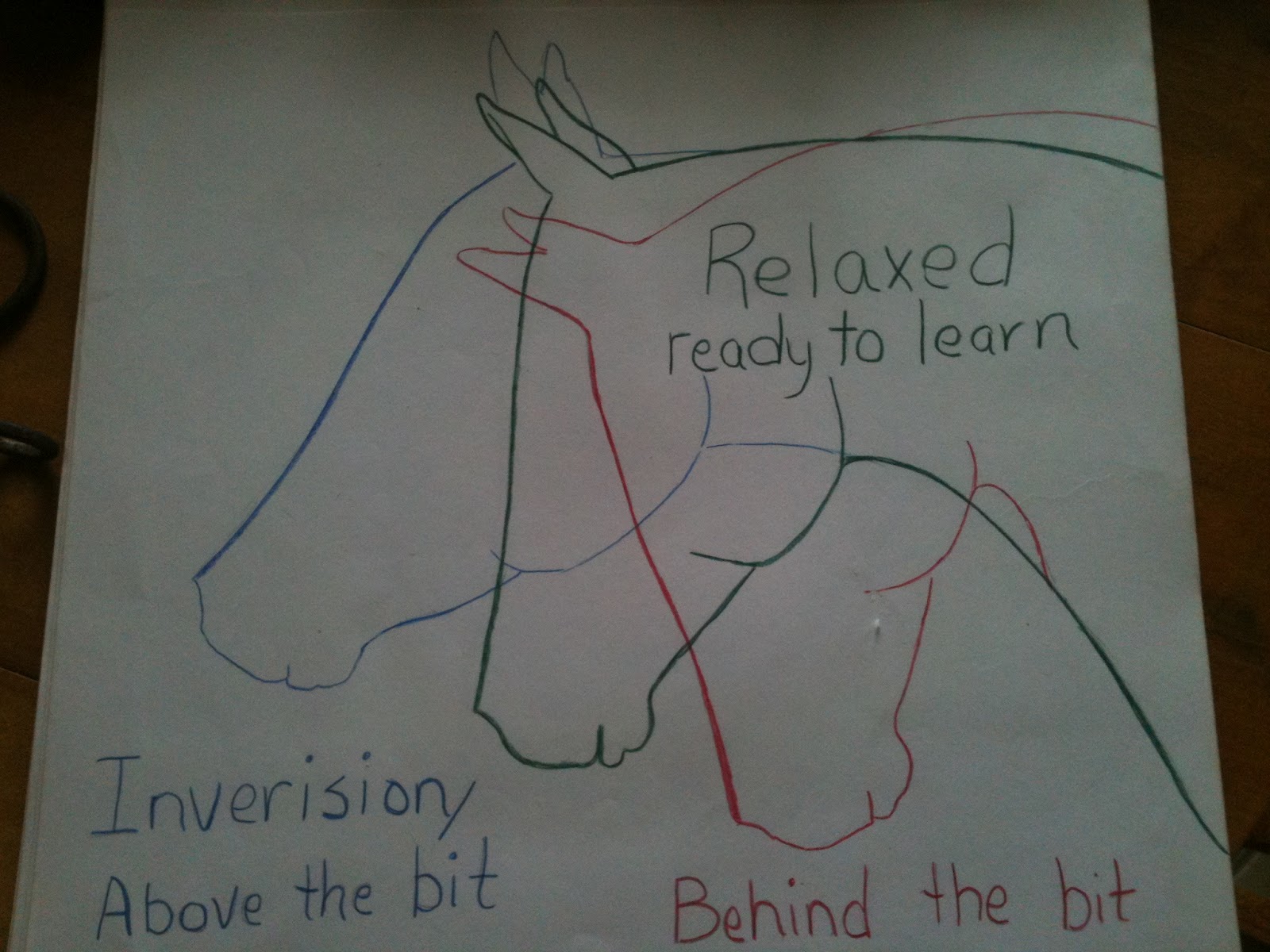
Good bits can wear out and cause resistance.

Damaged medium twist copper half cheek snaffle
Bottomline:
Pain, poor fit, and lack of training create resistance undersaddle, and a harsher bit should only be used after all other aspects have been explored.
A bit is never a subsutite for training.
Stay tuned for snaffle bits!
Tuesday, July 10, 2012
Now instead of dogs imagine horses
I really could not have said it any better myself. This is very much worth the read and is absolutely true of every equine relationship. Who are you? Andy or Barney?
http://terriermandotcom.blogspot.com/2011/12/what-would-andy-griffith-do.html
http://terriermandotcom.blogspot.com/2011/12/what-would-andy-griffith-do.html
Wednesday, May 2, 2012
Calm after the storm
Calm after the storm
Just last week I rode through a hell of
a storm. My horse in training reared sky high 3 times in a row over a
simple back up request while I finishing up my ride out in open
pasture, with a bum right ankle, and home alone (Why was I riding at
the time you may ask, because I'm a horse trainer I get paid to ride
no matter what is going on in my own life). All I could think as she
was going up was, “Aw hell, now I have to finish this.” So I did
finish it, I did, and she had to trot herself into a tizzy for
rearing up, and go back to the crazy trot circles every time she
tried to rear again. 15 minutes later she backed up nicely when
asked and I slide off. I will admit to being a little petty and
rewarding her with only a nice pat and the Babe the movie quote,
“That'll do, Pig, that'll do.”, only because I was in serious
pain with my ankle from her antics. Even in pain, even after a awful
ride by anyone's standards I was happy because I had successfully
ridden through the storm once again.
What is the storm? For me I have
experienced a storm on every horse I have ridden regularly (Of course
I am a trainer so I ride like one, and I expect my horses to do
reasonable things at reasonable levels in their training career, and
I am never just a passenger), it usually occurs 2-3 weeks into
training after quite a bit of sloppy resistance on be half of the
horse who usually has never done anything in its life beyond being
haltered and brushed. So when I step in and expect attention, energy,
and effort for the first time ever their lives they rightfully suffer
a little culture shock and resentment. So we plug along, riding
because we have to until the horse suddenly says, “Enough is
enough, I liked my life before, and I don't like backing up, trotting
circles, being caught, etc, so I'm not going to it any more, so make
me, or leave me alone!” This is the storm, your horse has decided
to challenge you, and you only have two options; win, or back down.
Win or back down. You can only do one,
and the one that you choose will have great consequences in your
horse life. If you choose to win you will get to experience the
thrill of the calm after the storm, or if you choose to back down your
horse will only become more and more resistant. I always have chosen to
ride through the storm (and believe me I have been in some
spectacular storms) because I know that on the other side of it we
will have an understanding, I will have a better horse, and in many
cases the beginning of a true partnership. Let's just say that when
your horse has dished out a 150% and you are still willing and ready
to ride you finish the ride with a ton of “pasture cred” to say
the least.
In my horse life after every storm I
have always achieved a major break through. So much to the fact that
I welcome storms because I know that they are the beginning a much
better chapter in my riding life. I know that after a rough ride,
99% of the time I will have a good stretch of clear sailing up ahead.
My horse in training has once again been another perfect example of
what riding through the storm can get you, she was 100% better on the
next ride and every ride since all because I was willing to call her
buff and say, “Yes you can, and yes, you will.”
Are you willing to ride through the
storm? If so I will meet you on the other side, which feels a lot
like heaven.
Please note that all horses were in
perfect health and care at the time of all bad behavior, and all had
been evaluated for reasonable pain causes for bad behavior prior to
being put into training.
Monday, April 23, 2012
Pony see, pony do
Growing up every horse we had always clipped wonderfully. And by wonderfully I mean, ground tied, rope hanging around their neck, head willing held whatever level needed next to the telephone pole, with a huge set of clippers made for body clipping. This was how my Mother clipped her horses then, and this is still how we do it today (but with barns, and better clippers). Now you may think that we spent weeks and weeks teaching every single horse over the years to clip in such a nice manner, but it actually was achieved very simply but just tying/holding every single new horse we purchased right next to every horse that was really good for clipping while we clipped before turning the clipper on the new horse. Using observational learning or put it simply the concept of Pony See Pony Do (so much better than the monkey).
Think about as it if you had lived a average horse's life, (only experienced normal horsey things; grass, stalls, trees) you too would probably think that a loud buzzing clipper near your face could only mean that person in charge of it was trying to kill you. But if you were allowed to see other people face the clippers who were not afraid of it, you probably would feel much better about allowing it near your face. Foals learn by watching their mothers, you learned to cook by watching your mother. Learning from others is natural and basic means of survival. So why not use this survival instinct to your advantage when training?
Around here I use this type of training with every single horse that comes through the door. Just last week I once again witnessed the awesome power of observational learning with Fancy.
Fancy came here at 6, broke as a 3 year old, then never handled, and this is her story of how she learned to be caught in open pasture.
Day 1: Slightly resistant to being caught in the stall.
Day 2: More willing to caught in the stall, was let out with other horses.
Day 3: Did not want to be caught in open pasture, forcing a 2 hour chase by lawn mower (yes I said lawn mower, and no she was never in any danger, just kept moving at a slow and steady pace), was unwilling touched at the end.
Day 4: The moment Fancy sees me she takes off, I go out and just catch my horses, who will come when called, and always stand for as long as it takes to get the cookie they get after getting their halters on. Ignoring her, I tie them and start grooming. She follows and watches, and eventually stands for brushing, using 3 cookies she is caught within 10 minutes.
Day 5: She runs away, I catch my horses, not wanting to be left out Fancy follows, and is caught as soon as I finish tying my own.
Day 6: She turns away but chooses to stay, I halter my own horses, then proceed to Fancy, she grudgingly accepts the halter.
Day 7: She turns and faces me as I approach, and is willing caught after my horses.
Day 8: She is over by the arena when I step outside(100 yards out), and she trots over and insists on being caught before Charlie.
Day 9: She had been perfect so far ever since.
Now lets break down what happened.
Fancy was in a new environment, her only sources of companionship were my horses. Over time by seeing over that over that my horses (all the horses in her environment) where happy to be caught, and even looked forward to it, Fancy eventually decided that she too could and should be happy about caught. Depending on how she is reintroduced in her home environment she should maintain her willingness to be caught. However if she were immediately turned out with other horses who ran away she would probably revert back to her previous behavior.
Making observational learning work for you.
The only tools you need to use this method is one or more really good role model horses who do exactly what you want the new horse to do perfectly every time. Over the years I've used this approach for clipping, grooming, trailering, tying, bathing, saddling, hoof trimming, you name it. I so believe in observational learning that I show every new horse how it is done by first doing it to my own horses and letting them watch. After watching two other horses sleep while being saddled you would be amazed at how well the new guy can take it. Don't let not having a model citizen in your herd stop you. Most boarding barns have a few model citizens you could ask to borrow for a few hours, or talk with your horse friends and see about setting up some time to work together work on your problems or show your new horse how it is done.
Friday, January 13, 2012
Equine Definitions
Today I've decided to compile a list of unofficial horse definitions. It's funny what can pop into your head at 5am.
Trailer Trasher- A horse who trashes the walls, floor, and possibly even ceiling of the trailer with muck and urine.
Egging/Egged- When you are riding and your horse warps your circle an a certain direction, usually towards the barn, gate, or other horses. Use: Your horse is egging your circle every time you pass the gate.
Green- A inexperienced horse or rider.
Green Squared- A inexperienced horse and rider working together.
Stall Trasher- Same as Trailer Trailer but in a stall.
Barn Sour- Any horse who throws a fit about being ridden out away from the barn.
Buddy Sour- Any horse who throws a fit when separated from their horsey friends.
Fear Rider- Any person overcoming their fear of riding.
Turkey- A term of endearment. To be substituted for a name when you are super pissed at your horse. Especially useful when children and people you should not curse around are present.
Pumpkin- A term of endearment. To be substituted for a horse's name when you do not know their name, or you are a pleased with their progress or behavior.
Expressive- A nice way to say your horse is a bitch.
Opinionated- Another nice way to your horse is a pain in the back side.
Discussion- What happens when a horse acts out in a such a negative/dangerous way that requires correction. As in, "Today Red and I had a discussion about rearing."
Riding- The art of keeping a horse between you and the ground. (not mine but still funny)
Added Definitions
Dressage-The art of riding.
Communication- What happens when a rider listens to their horse.
Team- The bond that results from hours and hours of communication.
Can't- The frame of mind that prevents horses or riders from achieving success.
Training- What happens from the moment you step foot in the barn until moment you leave.
All of a sudden- What happens when you are not paying attention.
Guest Definitions
Cassandra Was Right
"Bombproof" - an adjective used to describe a horse that cannot be startled or surprised by anything - until the day that a lost party balloon a quarter mile away causes it to perform a 400-foot-record lateral quantum displacement.
Please feel free to add new ones by commenting and I will add them to the list.
Trailer Trasher- A horse who trashes the walls, floor, and possibly even ceiling of the trailer with muck and urine.
Egging/Egged- When you are riding and your horse warps your circle an a certain direction, usually towards the barn, gate, or other horses. Use: Your horse is egging your circle every time you pass the gate.
Green- A inexperienced horse or rider.
Green Squared- A inexperienced horse and rider working together.
Stall Trasher- Same as Trailer Trailer but in a stall.
Barn Sour- Any horse who throws a fit about being ridden out away from the barn.
Buddy Sour- Any horse who throws a fit when separated from their horsey friends.
Fear Rider- Any person overcoming their fear of riding.
Turkey- A term of endearment. To be substituted for a name when you are super pissed at your horse. Especially useful when children and people you should not curse around are present.
Pumpkin- A term of endearment. To be substituted for a horse's name when you do not know their name, or you are a pleased with their progress or behavior.
Expressive- A nice way to say your horse is a bitch.
Opinionated- Another nice way to your horse is a pain in the back side.
Discussion- What happens when a horse acts out in a such a negative/dangerous way that requires correction. As in, "Today Red and I had a discussion about rearing."
Riding- The art of keeping a horse between you and the ground. (not mine but still funny)
Added Definitions
Dressage-The art of riding.
Communication- What happens when a rider listens to their horse.
Team- The bond that results from hours and hours of communication.
Can't- The frame of mind that prevents horses or riders from achieving success.
Training- What happens from the moment you step foot in the barn until moment you leave.
All of a sudden- What happens when you are not paying attention.
Guest Definitions
Cassandra Was Right
"Special" - a truly and genuinely stupid horse. As in, "We need to give Ringo a little more time to figure out how to get through an open gate. Remember, he's special.""Lateral quantum displacement" - when a startled horse shifts position at least ten feet sideways in less than a nanosecond, leaving the rider suspended in midair.
"Bombproof" - an adjective used to describe a horse that cannot be startled or surprised by anything - until the day that a lost party balloon a quarter mile away causes it to perform a 400-foot-record lateral quantum displacement.
Please feel free to add new ones by commenting and I will add them to the list.
Wednesday, December 7, 2011
All of a Sudden
It seems like 99% of all horse accident
stories begin with the wondrous phrase “all of a sudden.”
We hear it everyday. The ride was
going perfect until “all of a sudden” the horse; kicked, bucked,
reared, bit, etc.
One of my favorite examples of this
phenomenon was on a quiet trail ride where I meet a grandmother and
her granddaughter both on well broke horses. I was riding behind
both them when mid way through the ride I see the granddaughter's
gelding slowly start riding up the rear of the grandmother's mare.
The mare from the moment it started was obviously pissed.
I warn them to back off, but they
ignore my comments. So the mares starts pinning her ears, and
wringing her tail.
I warn them again that they need to pay
attention and get off the mare's rear, I guess they didn't hear me or
the mare. So Mare adds chomping the bit, and begins glancing back
with road rage to the already pinned ears and wringing tail.
I tell them to back off, that the mare
is on her way to blowing a gasket, and of course they didn't listen.
So Mare adds pissed off jig to the pinned ears, wringing tail, etc.
This goes on for about 15
minutes........
when “ALL OF A SUDDEN” the mare
kicked!
Suddenly the mare
was bad, she was wrong, by the words of the grandmother, “a
terrible horse.” She just couldn't believe that that mare would do
such a thing.
It never crossed their minds that the
whole incident was their fault. Even after I explained the situation
play by play.
You mean I can't just sit back and
enjoy the scenery while riding like when I'm a passenger in a car?
That I actually have to pay attention to what my horse and the horses
around me are doing when riding. What did you think was happening
when your mare pinned her ears and started acting up? Do you do the
same thing with your car? That check engine light comes on for a
reason you know.
After the ride as I walk past their
trailer to hear the Grandmother exclaim over the phone, “Then all
of a sudden (insert name) kicked!”
If you happen to experience “all of
a sudden” stories regularly in your horse life, chances are you the
one are causing the problems or ignoring them, especially if you are riding a well seasoned horse. Riding is just like driving you can never
fall asleep at the wheel. I've had plenty of interesting moments on
green horses, but as a rider I expect green horses to freak over
anything and everything.
In my riding life I have only
experienced one true “all of a sudden” moment. It happened when
I was a kid riding in the woods with my Mom. My horse was quiet and
on a loose rein, when “All OF A SUDDEN” a tree fell about 30
yards away, and my horse took off like a bolt of lightning. I
regained control about 50 yards later, and circled until my horse was
ready to continue once again on a loose rein.
Maybe it should be changed it to, “Suddenly I wasn't paying attention when.....”
Monday, November 28, 2011
How to Blanket Safely- Part 2
After you can comfortably approach and
touch your horse all over with the blanket you can now start the
process of blanketing.
Only after my horse is completely
comfortable with the blanket do I actually attach it to their bodies.
A scared horse can spook and get away from even the most experienced
horsemen, and I do not want my horses to injure themselves trying to
get away from a scary half attached blanket that is chasing them. If
I am not certain a horse can handle the blanket and blanketing
process they stay in the barn and or do not get blanketed plain and
simple.
Different blanket style require
different techniques.
Open Front- Your standard horse
blanket has buckles/closures in the front and straps for across the
belly. Before I approach my horse with the blanket I am sure that I
have it in reasonable order. I generally carry over my on my right
arm half folded like the back of your horse with the front of the
blanket towards my hand. This allows me gently place the blanket
over the back. After it is placed I then attach my blanket in the
front first.
Closed Front- These blankets
require you to place it over your horse's head like a t-shirt to get
it on. Personally I am not a fan of Closed Front Blankets because I
find them very cumbersome with tall horses especially when you are
short, and are they are hard place on head-shy/ear-shy horses. Not
because I do not believe in teaching horses to handle/allow your
hands in those areas, but because they do not allow you to release
for good behavior when your horse allows you to handle those areas,
which is not helpful in the retraining process. But if you do happen
to own one you need to put it on your horse like you do your own
t-shirts. You don't drag it all over your face and hair, you scrunch
it up with the neck hole open and gently place it over your head. I
can pretty much guarantee your horse will be better for blanketing if
you use the t-shirt approach.
Belly Straps/Bands- Blankets
can have up to 3 straps. If there is one strap you should attach it
straight across. For two straps you cross them under your horse's
belly, and if there are three straps you will cross the outer two and
use the middle strap straight across to the other side. If my
blanket has a belly band I attach it accordingly. Allow for a hand's
width on all straps, they should not droop and hang far below their
belly.
Leg Straps- If your blanket has
leg straps they can be attached front to back on the same leg or
crossed in the center to the other side. All legs straps should be
well adjusted and not too loose.
Thursday, November 17, 2011
Blankets and Blanketing Explained
Blankets and Blanketing Explained
In honor of the great winter weather we have been having and the current blanket
sales going on I have decided to write about blankets and blanketing today.
Question 1: Do I need to blanket my horse?
Answer: Unless your horse is body clipped he should be able to do fine without a blanket. Some breeds are less tolerant to cold such as the Arabian and Thoroughbreds. Some horses don’t put on a thick winter coat and might need a little help. Mares as with woman have more body fat and are generally more tolerant to the cold than geldings and stallions. Young and older horses are at greater risk and may require blanketing. Every horse is unique.
Question 2: Do you blanket your horses, if so when?
Answer: Yes I do blanket my horses’, they each have two blankets (turnout sheet and midweight turnout). When it is dry I blanket when it will be in the 30s or lower for an extended period of time. When it is wet and above 50 degrees I do not blanket. When it is wet and it below 50s I blanket according to the horses’ needs. My gelding Charlie always needs his blanket before my mare Pie. When it is raining and 40s or below I always
blanket.
Question 3: Can I blanket my horses wet?
Answer: Yes, if the blanket is breathable and waterproof (can only be breathable if you horse will stalled or otherwise removed from the rain). DO NOT blanket your horse in wet weather if your blanket is not waterproof, think about the last time you got soaked to the bone and was not able to change clothes, your horse can’t take off the blanket without your help. Note: over time your waterproof coating can wear away so it is important that you check blankets regularly, and wash them using a product made for horse blankets to further preserve the waterproofing.
Question 4: Can I just leave my blanket on throughout the winter?
Answer: No, especially in a climate like 20s the next. Most horses already put on a fair amount of winter coat, and do not need a blanket 24/7. You also need to check your blankets for fit, waterproofing, and the horse’s skin for any problems on a regular basis. Covering any part of the body for an extended time can result in skin
issues, and sunlight/air is a great preventative for most minor skin problems. If
you have ever worn a cast before, you can probably remember how it felt the day you got it removed and how your skin looked in comparison.
Question 5: What is the difference between a turnout and a stable blanket?
Answer: A turnout blanket is generally waterproof, more durable, and made to be worn in the elements. A stable blanket is not waterproof or as durable as a turnout.
Question 6: What is 240D, 600D, 1200D?
Answer: D= Denier or how durable a blanket will be (this also depends on the horse who will be wearing it and the other horses around).
420D- Light Durability- recommended for spring/fall when grass is available
and horse does not test blanket.
600D- Standard Durability- Recommended for horses easy on blankets.
Occasional or monitored turnout.
1200D Polyester or Ripstop Nylon- Superior Durability- Recommended
to withstand the demands of turnout.
1680D Ballistic Nylon/1800D Polyester- Exceptional Durability- Recommended
for horses that are hard on blankets or turned out with other horses who may bite or pull a blanket.
Question 7: What weight blanket do I need?
Answer: It depends on your horse’s coat, cold tolerance, and your average winter temperatures. Living in and a waterproof sheet, in extreme weather I can use the sheet to layer with for more protection.
Question 8: What if I only want to buy one blanket?
Answer: Buy a waterproof turnout blanket/sheet based on average temperatures in your area. Turnout blankets can always be worn in the barn but stable blankets should never be worn in the pasture. Buy 1200D or higher.
Question 9: How do I measure for a blanket?
Answer: Most of the time you measure from the center of the chest to the center of the tail. Not all blankets are measured the same so do your research on the brand that you are looking to buy as with clothes; one brand’s 6 is another brand’s 8. Your blanket should fit your horse properly and not be too big or too small both of which are uncomfortable. A blanket that is too big or very ill fitting can be dangerous as the horse may get tangled up.
Now is a great time to buy blankets if you are in the market for one.
My favorite places to find blankets are: |
Rain and the power of good role models
A good role model can go a long way in educating the inexperienced horse. We had some fun out in the park after our arena work, and came across a park employee carrying sticks on his golf cart. Rain was in front with Pie ponying Charlie behind. Rain sees moving cart/rustling leaves and sucks back and bumps into Pie, Pie and Charlie never move but watch it pass, Rain still pressed against Pie also watches it pass and doesn't spook further. Cart passes and we continue like it never happened. Pie and Charlie kept Rain from spooking further because they did not validate her fear. Had they also reacted, Rain would have spooked further because they would have validated her fear/reaction by spooking with her. Good experiences the first time round make the training process much easier. Chances are that Rain will stand still or react even less the next time she sees a golf cart because of her experiences today.
Horses like to follow, and they generally follow the reactions of their peers/riders. For example- When out on the trail and your horse gets tense our first instinct is to also get tense/ready for a problem. Because you also got tense your horse gets even more tense, because he thought you thought being scared was a good idea. When riding I always try and lead with my emotions. If I feel my horse get tense, I stay loose and take a deep breathe, while I do have a plan of action if my horse does choose to spook, I expect them to follow my lead and stay calm.
Lesson of the day- Do not ever validate your horses fears, and when out for the first time try and have a good role model horse around to help your inexperienced horses make the right decisions.
From the beginning
In the world the horses are represented by two separate yet equally important groups: the horse owners, and the horse trainers who help them. These are their stories.
I am not one for long introductions, I'd much rather just jump in, but it's hard to tell a story without a little background.

Subscribe to:
Posts (Atom)