Thursday, September 6, 2012

Why I love clinics and why you should too

  Since the age of 7 I have in ridden and attended clinics.  Growing up we as a family spent our vacations hot, dusty, and horseback.  In our little white Bruton Easy Pull we logged hundreds of miles attending Aggie 4-h clinics, and riding with wonderful horsemen like Brian Summerall, and Bob Allen just to name a few.  My Dad would take care of us and the horses and my Mom always rode in the clinic with us.  I was picked up from school in a loaded horse trailer more than once.  Growing up clinics were almost magical, not only did we get to stall our horses and ride in a arena (super special when you do not have them) but we also had the chance to learn something new from someone besides Mom.  Years later as a adult I still love a clinic and here are some reasons why.

1. You get to ride in a group.-  Many of us ride alone or with just a few friends and family.  Attending a clinic allows you a largely unknown group horses to ride and interact with.  Because it is a training/learning environment it is a great place to socialize a horse.  

2. You have to haul.-  Attending a clinic forces you to confront your loading fears and problems.  Every horse and owner should be comfortable loading and hauling and most of us rarely have the chance to practice.  Going to a clinic is a great way to get you both out and about in a understanding training friendly environment.  At our clinics we always help when some is needed. 

3.  You can't beat a little distraction.-  Between the new surroundings and new horses there are a lot of distractions possible for your horse at a clinic that you can not get riding at home.  Attending clinics is one of the best ways to teach your horse to perform reliably in stressful and distracting situations.  Again being a learning environment you are able to do what your horse needs without issue.  

4.  Another Perspective.-  Many of us spend so much time working alone that we do not notice small changes in our horsemanship and riding.  A clinic allows for a fresh perspective on your riding and horsemanship from the clinician, and a chance to evaluate for yourself where you stand among your fellow riding peers.

5.  You can't beat the time horseback.-  Most riders average 20-90 minutes on a normal ride.  At a clinic you often spend 7-8 hours each day with your horse (not all of it actively riding).  Just as you really do not know someone until you have traveled with them, you really do not know your horse until you spend two 8 hour days with him.

6.  Practice makes perfect.-  I have probably attended at least 12 Aggie clinics in my lifetime, and while each clinic was taught by different students they all presented the same exact information year after year.  Why attend so many of the same clinic you are probably wondering?  Because each time I had the chance to re-enforce what I learned before and pick up/remember something new.  Because each time I got better, and each time my horse got better.  Eventually I had a different horses who each time got better.  Our horses have participated in on average 8 clinics each year for the last 4 years, not to mention those by others, and yet each time we find something new or something else to work on.  

7.  The bang for your buck.- Between the long hours, personalized and general instruction, the unique training opportunities, and one of a kind atmosphere you would be hard pressed to find more value for your time and money. 


Wednesday, August 22, 2012

Dressage gets The Colbert Bump

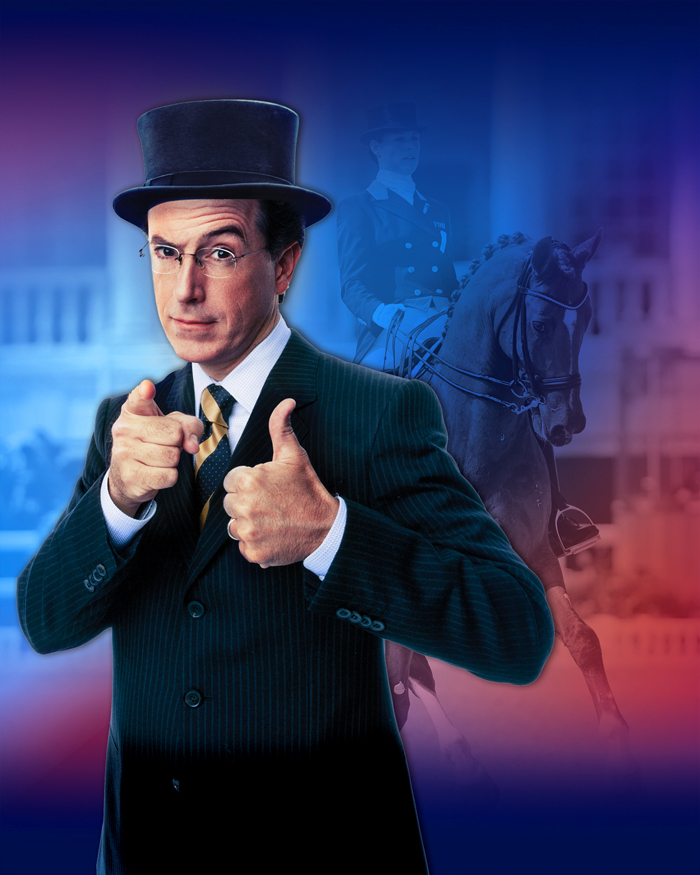
A wonderful thing happened recently in the horse world.  Thanks to The Colbert Report and Stephen Colbert with the help of Michael Barisone millions of people have been introduced to the sport of dressage and the world of horses.

Be prepared to laugh, I know I sure did; and be sure to share it with all your horsey and non friends. 

                                   Image from The Chronicle of the Horse

Stephen's Dressage Training Pt. 1
Stephen's Dressage Training Pt. 2 


And for a behind the scenes look check out this from The Chronicle of the Horse. 

Tuesday, August 14, 2012

Modern times, modern training problems

"It's my money and I need it now!"

Many of us have heard this annoying advertisement and yet many of us use the same philosophy in our horse life.

 "It's my horse and I need him to ___________ now!"

How did we get here?  When did we trade horsemanship for showmanship?

It happened when we put horsemanship on a deadline.  We need our horse to do ___________ because we have a show, trail ride, etc.  We have a date on the calendar which we can not ignore.

Now deadlines are not absolutely evil.  They can prompt us to ride, train, and can offer a gauge to our progress.  But they more often lead to short cuts in training which may pay off in the short term, but will eventually create major issues in the long run.  

I had a child horsehood without deadlines, yes I still had major horse events but I was taught as a small child that a horse will always show you what he needs, and that if he is not doing it he is not ready for it.  Knowing this I rode until things got better, I rode until things clicked and my horse was ready, and then I rode even more.

I was taught that good horses are born but great horses are made and that every great horse had someone in their life willing to ride through it all to find the wonderful horse inside.

As I've gotten older I have realized that what I learned as a kid is the right way.  There is no magic trick to fix your problems except to go back to the basics.  It takes me 4-5 years to "finish" (for lack of a better term, because you can always improve, horses are never finished in my book) a horse. How long does it take you?

Just ride, things will get better. Eventually everything will come together.  I promise.    

Wednesday, July 25, 2012

Death of the Join-Up?

Yesterday this link to research done by the University of Sidney was floating around online:

Researchers urge rethink of 'Monty Roberts' horse training method

Below you can find my response to their findings and observations:  

The data did prove that you do not need to act like a horse to be successful, but also that pressure and release works (which we already knew).  I would like to (as the article suggested) know what the researchers themselves consider to be humane treatment when initiating contact a 1,000lb prey animal. 

I will admit that the Join Up really does get miss used by the public.  I'm sure many horses think their owners have brain damage because they just keep doing the same thing over and over.  I myself use it only until I can catch the horse, and I don't use it unless I need to teach a horse to be caught.   

What it did prove (according to me) is that robots are as good or better than humans at training horses because they offer no emotion to influence, add to, or confuse the horse.  The talk about being a good leader or herd boss is really all for us humans to better project a cool, calm, and collected image to the horse.  All the talk is just a mind game used to convince owners to loosen up and stop being a doormat.  The horse could careless on how a person presents themselves, they just react to how you do it.  Even after 10 years together if this week I presented myself as a doormat Pie would treat me as such.        

It proved that you just have to speak clearly and consistently in order to "speak horse".  I'm quite certain that if they had continued the experiment using only pressure and release they could taught the horses just about anything.  

Friday, July 20, 2012

Bits and Bitting Part 4: The truth about snaffle bits

The Snaffle Bit.  

Every horse owner has one or has used one at one point in time, and it is widely (and blindly) accepted as the softest and most humane bit available.


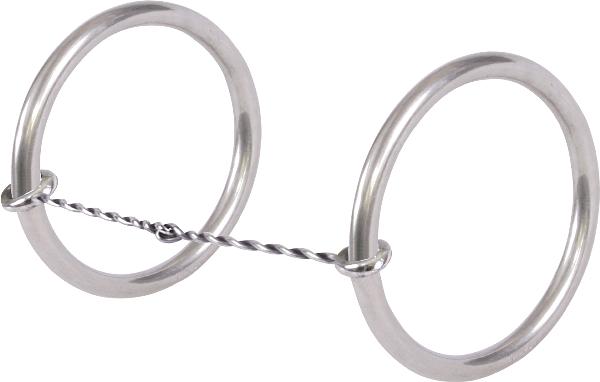
In the book "A Whole Bit Better"  By Dale, Ron, and Bob Myler a snaffle is described as a ring bit, "The rings may be round, oval, or shaped like a "D."  A loose ring allows the mouthpiece to rotate around the ring; a fixed ring does not.  Both the headstall and the reins are attached to the ring.  When pressure is exerted through the reins, the bit pulls with the same amount of pressure backward on the horse's mouth; thus a ring bit is often called a direct action bit."

Simply put true snaffle bits are direct action, non leverage bits. 


Meaning that pound for pound your horse feels the exact amount of force you use.

A snaffle is only a snaffle when the mouthpiece, reins, and bridle are all attached to to the same ring. 

A snaffle bit may have any type of mouthpiece.


All of these bits are snaffle bits because the mouthpiece, bridle, and reins all attach to the same ring. 

 Just because a bit is called a snaffle does not mean that it is humane.


Direct Rein Bits work by contacting the palate, bars, tongue, and lips.


The mouthpiece and the amount of pressure used by the rider determines the severity of a snaffle or direct rein/action bit.

A straight mouthpiece can create a nutcracker effect on the tongue and bars.

While a more curved mouthpiece will not immobilize the tongue.

Which would you put in your own mouth?
                          1                                                                                                      2

3                                                              4

I have used 1, 3, and 4, based on each individual horse's preferences, but never number 2.


In closing a snaffle is a direct rein bit.  

A snaffle is only a snaffle if the mouthpiece, bridle, and reins are attached on the same ring.

The severity of a snaffle bit is determined by it's fit, construction, and amount of tongue relief provided. 

A straight bar mouthpiece like number 2 (disregard the twist, looking only at the straightness of the mouthpiece) is more severe 1, 3, and 4. 

Bit number 3 is more severe than bits 1 and 4 due to the amount of tongue relief available.

A twisted mouthpiece is more severe than a smooth mouthpiece.

A smooth twisted mouthpiece is less severe than a square, or fishback twisted mouthpiece. 

The thinner the mouthpiece the more severe.


Stay tuned for Curb/Leverage Bits coming soon.  


Monday, July 16, 2012

Keeping a good horse honest

Yesterday my friend came by to deliver a chicken (long story) and while we were outside talking near the horses Charlie immediately came up and offered to join the conversation while Pie (unlike her normal self) choose to stay back and did not offer to come forward.  Busy enjoying the conversation I put her odd behavior out of mind until walking back from closing the front gate. 

You see Pie is a attention hound, and she loves people.  She will drive you crazy with "moral support" when working outside, and she actually asks to be caught.  Needless to say I found her indifference troubling.

Then I realized that Pie had never seen my friend or her car before and had assumed that I was about to give a riding lesson.  She has to do it time to time and when Charlie was recovering last fall and winter she had to take over his riders all of whom were beginners, and she does not enjoy teaching beginner adult riders.

Pie likes a skilled rider or someone small enough (kid) that they do not bother her with their aids.  She likes a confident rider with a decent seat, someone who understands and uses leg cues, and someone who works with her instead of holding her back.

Charlie on the other hand seems to really enjoy giving beginner lessons.  A former ranch horse in the states of Montana and Wyoming, he appreciates a rider who only wants to walk and trot if that.  In a soft as butter bit and good fitting saddle he doesn't mind gripped knees, and heavy hands.  He loves the attention though, he soaks it up like a sponge.   

So what does any of this have to do with keeping a good horse honest?

A good horse must enjoy their job to stay honest. 

Any horse repeatedly put into situations they do not like will start to act out.  Pie put into a busy beginner lesson program would probably turn into a very bad horse very quickly. 

Now does this mean that because Pie hates beginner lessons she will never have to give one again? 

No, If I need her to she can and will give a great beginner lesson. But knowing that she hates it and in the interest of keeping her happy and honest long term I will not ask her to give one unless absolutely necessary.  I would much rather have a happy horse ridden by a few than a super pissed horse ridden by many. 

Long story short, in order for a horse to remain good and honest they must like the work that they do.  A unhappy horse will act out and possibly become dangerous over time.  Negative changes in behavior, personality, and habits when trying new sports/situations may mean that your horse does not like what you are doing.  While this does not mean that a horse should be exempt from anything they do not like.  A horse will never excel when forced and unhappy.

Happy Horse = Good and Honest Horse