Friday, July 13, 2012

Bits and Bitting Part 3- Resistance- The root of all bits

 Resistance- the refusal to accept or comply with something; the attempt to prevent something by action or argument.

A few common examples of resistance in horses:   

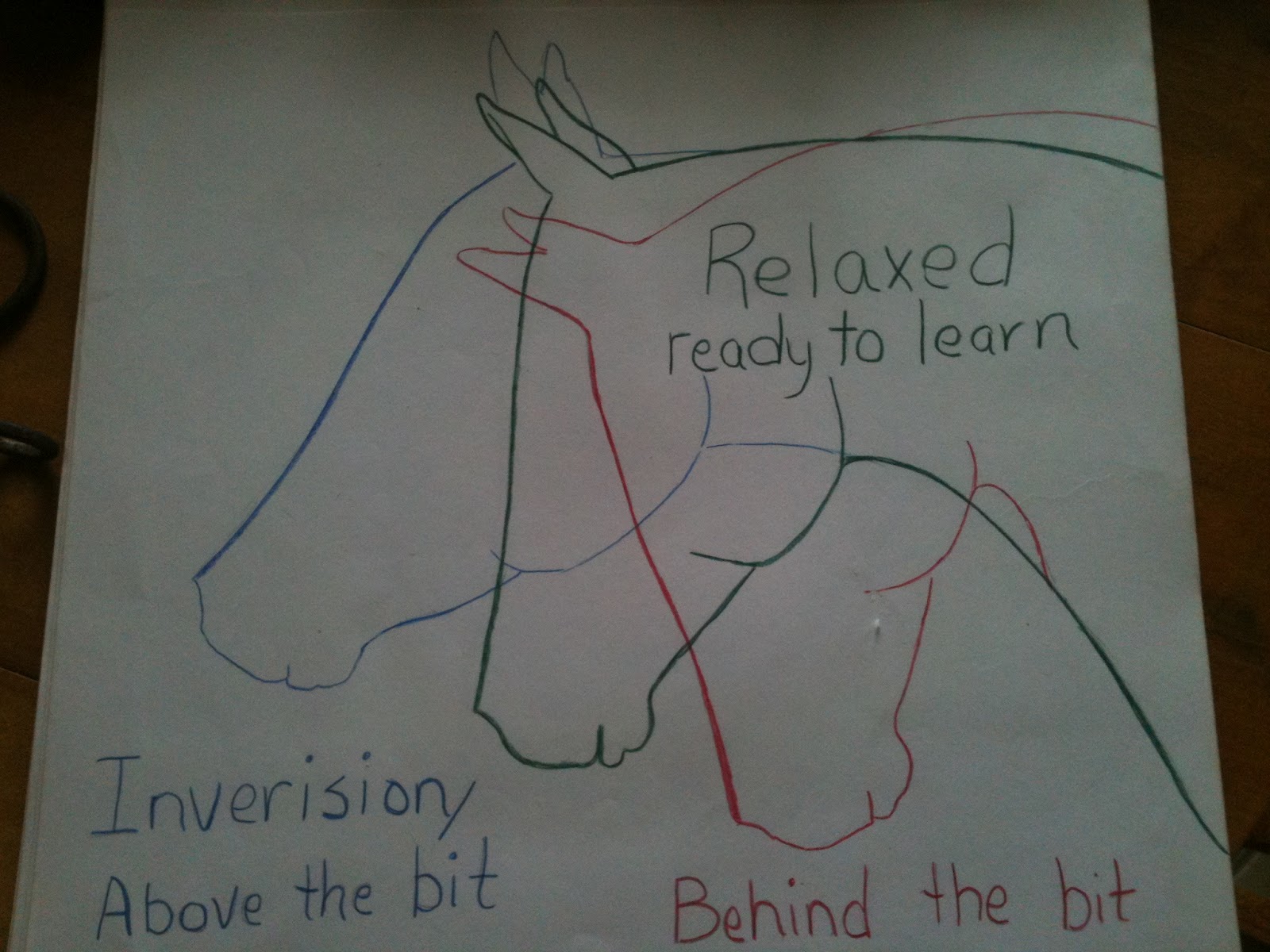
Getting behind the bit
Inversion
Running through the bit
Dropping the shoulder
High or tossing head
Gaping or busy mouth
Unyielding neck
Tipping the nose to the outside
Pushing out against the reins 


Resistance is direct result of:
Pain
Fear
or
Lack of Training

Now you must be asking yourself why I'm talking about resistance in the middle of a biting discussion, because we as riders often use bits to fix resistance, and that the more resistant a horse is the harsher is bit that should be used. 

(yes that is a bike chain bit, these are from our evil bit collection)

Bits can create resistance through poor fit, pain (from the bit or from needing dental work), fear,and lack of training.


Good bits can wear out and cause resistance.

Damaged medium twist copper half cheek snaffle

Bottomline:
Pain, poor fit, and lack of training create resistance undersaddle, and a harsher bit should only be used after all other aspects have been explored. 

A bit is never a subsutite for training.

Stay tuned for snaffle bits!


Tuesday, July 10, 2012

Now instead of dogs imagine horses

I really could not have said it any better myself.  This is very much worth the read and is absolutely true of every equine relationship.  Who are you? Andy or Barney?

http://terriermandotcom.blogspot.com/2011/12/what-would-andy-griffith-do.html

Friday, July 6, 2012

Bits and Bitting Part 2- Anatomy

What about bits? 

This is something that has always bothered me.  We worry about, discuss, and research; feeding, saddle fit, and hoof care and yet we are more than happy to shove any random piece of metal in our horse's mouth and ride around. 

Why are we willing to take someone else's word and recommendation without any understanding of what we are actually putting in our horses mouths?   It's time we start talking about bits, and the discussion starts right now.  

 
Egg Butt Snaffle- immobilizing tougue, clamping nutcracker effect on bars, mouth open in resistance 

Loose ring snaffle- pushing through soft pallet, nutcracker effect on bars


I did not just wake up one day and decide that I wanted to know everything possible about bits.  My father's lovely mare was the true inspiration and the beginning of my journey because no matter what bit you put her in mouth she would fuss/fiddle with it constantly. Which after trying every bit we in the barn lead my Mom and I to start looking for a solution, and what we found was a wealth of information and as a result some very happy horses. 


In order to begin to understand bits we must first understand a little basic anatomy. 


Artwork by Cathy Sullins
8yr old mare paint mare

It looks like you have plenty of room for any size bit until you get to the real life photo.  When taking this photo we were astonished at how much room the tougue actually takes up.

While all horses have the same structures (plus or minus wolf teeth) no two mouths are alike, and individual characterists can play huge role in finding the correct bit.  
 
Would both these horses do equally well in the same bit?


Probably not, the one on the right will require much more tougue relief than the horse on the left.

Factors to consider when choosing a bit-
1. Head shape- Generally the courser a horse's head and muzzle the meater the mouth and tougue, which calls for more tougue relief.
2. Age- A horse's mouth changes constantly throughout it's life. So the bit that works perfectly at age 5 may hurt by age 15.  Check out  http://rogueequine.com/services/dentistry/ for a great general write up on equine dentition.
3. Past History- Some horses may have permanent damage from previous bits causing them to not respond to certain types of pressure. 
4. General Dental Health- Young horses may be cutting teeth causing them to react negatively to certain bits at certian times or older horses may have loose or missing teeth.  


Is your young horse being naughty, maybe it's his teeth.
Common ages for tooth eruption.
Type of toothNumberDeciduousPermanent
IncisorFirst (central)birth to 8 days2.5 yrs
IncisorSecond (intermediate)4.5–6 weeks3.5–4 yrs
IncisorThird (corner)6–9 months4.5–5 yrs
CanineAbsent3.5–5 yrs, some around 6 yrs (if ever)
PremolarFirst (wolf)Absent6 months to 3 years (if ever)
PremolarSecondbirth to 2 weeks2–3 yrs
PremolarThirdbirth to 2 weeks2.5–3 yrs
PremolarFourthbirth to 2 weeks3–4 yrs
MolarFirstAbsent9–12 months
MolarSecondAbsent2 yrs
MolarThirdAbsent3–4 yrs


 Unlike hospital sock bits are not one size fits, and should be considered and fitted on a individual basis. 


Stay tuned for Part 3- Resistance


Monday, July 2, 2012

Bits and Bitting Part 1- One of these pictures is not like the others

For the last few years my Mother and I have done a biting presentation as a part of many of our clinics.  This month I will adapting our presentation into multiple blog posts. Today we start by gaining some perspective about how bits affect our horses.


At first glance what do you think this horse is thinking?


now


What do you think this horse is thinking?


now


What do you think this horse is thinking?


Answers:

Horse 1: "OMG! THERE IS A LION ON MY BACK, I'M GONNA DIE!"

Horse 2: "OMG! I CAN'T ESCAPE THIS BIT, I CAN NEVER ESCAPE THIS BIT!  WHAT DID I DO TO DESERVE THIS!"

Horse 3:  "Oh boy, What are we going to do today?"


Which horse do you think is focused in a positive way on his rider and is willing and ready to try and learn?


Stay tuned for tomorrow's post where we follow up by talking about bits in general and signs of resistance.


My tack collection obession explained


My trailer bridle rack, holding some of my favorite tools.


 My tack collection obession explained.   

I get it honest.  You see I grew up in a tackaholic horsehold.  Much as other women collect and cherish jewelry or shoes, my Mom was and still is all about bits and leather.  Growing up with her (a skilled amateur trainer) I was always taught to use the right tool for the job, and that the right tool may be different for each horse so it is important to have options.  So I grew up with a tackroom filled with bits and bridles of every kind imaginable with all being useful and important in some form or fashion.  Some pieces were there because she wanted to study them further, others because she wanted to try them, some were there because they were great and just not needed at the time, and others still were there simply because they should never be used again (abusive/inhumane bits, we collect them to educate people and to keep them away from horses).

Simply put every piece in both our collections has been collected with care and consideration.  So the next time you think our tack rooms or trailers are cluttered just remember that for some horsepeople every piece has a purpose.

P.S. - Thanks Mom you did raise me right.  (I think she has finally figured out how to access this thing)


Monday, May 14, 2012

Know your normal- A colic story


My gelding started to colic Friday afternoon. My first indication that something was wrong was the fact that he was laying down in a odd place (not the normal napping spot). So I called out and he got himself up but immediately started wanting to go down again. This was all the information I needed to spring into colic mode and start treatment. Up catching him I noticed his breathing was a bit labored and he was starting to sweat. When I had called him he did poop while up which allowed me to feel comfortable about giving him some Banamine. After the shot we started walking and within 20 minutes Charlie was feeling much better, and within the hour he was in the stall normal once again happily munching hay. My theory to the actual cause of our colic episode is that with all the rain we had last week a dormant plant/seed started growing in the pasture and Charlie ate it and as a result got a tummy ache.

Now the title of this post is know your normal. Given that Charlie was a good ways out in the pasture if I had not taken notice of his odd napping/lying down location (which made me investigate further) there is a good chance he could have suffered for several hours or even through the night before getting treatment. If he had not gotten early treatment (he was absolutely normal when I saw him out 3 hours earlier) there is a much greater chance that we would have had to go to the vet (and I was ready to do so if he had not shown such improvement early on) or worse he could have twisted his gut and required major surgery.

The moral of the story. Horses are creatures of habit, any changes in their behavior could mean there is something very wrong. While horses can not verbally tell us where it hurts, by knowing your horse's normal everyday behavior and habits you will be better able to tell when something is not right.     

Wednesday, May 2, 2012

Calm after the storm


Calm after the storm

Just last week I rode through a hell of a storm. My horse in training reared sky high 3 times in a row over a simple back up request while I finishing up my ride out in open pasture, with a bum right ankle, and home alone (Why was I riding at the time you may ask, because I'm a horse trainer I get paid to ride no matter what is going on in my own life). All I could think as she was going up was, “Aw hell, now I have to finish this.” So I did finish it, I did, and she had to trot herself into a tizzy for rearing up, and go back to the crazy trot circles every time she tried to rear again. 15 minutes later she backed up nicely when asked and I slide off. I will admit to being a little petty and rewarding her with only a nice pat and the Babe the movie quote, “That'll do, Pig, that'll do.”, only because I was in serious pain with my ankle from her antics. Even in pain, even after a awful ride by anyone's standards I was happy because I had successfully ridden through the storm once again.

What is the storm? For me I have experienced a storm on every horse I have ridden regularly (Of course I am a trainer so I ride like one, and I expect my horses to do reasonable things at reasonable levels in their training career, and I am never just a passenger), it usually occurs 2-3 weeks into training after quite a bit of sloppy resistance on be half of the horse who usually has never done anything in its life beyond being haltered and brushed. So when I step in and expect attention, energy, and effort for the first time ever their lives they rightfully suffer a little culture shock and resentment. So we plug along, riding because we have to until the horse suddenly says, “Enough is enough, I liked my life before, and I don't like backing up, trotting circles, being caught, etc, so I'm not going to it any more, so make me, or leave me alone!” This is the storm, your horse has decided to challenge you, and you only have two options; win, or back down.

Win or back down. You can only do one, and the one that you choose will have great consequences in your horse life. If you choose to win you will get to experience the thrill of the calm after the storm, or if you  choose to back down your horse will only become more and more resistant. I always have chosen to ride through the storm (and believe me I have been in some spectacular storms) because I know that on the other side of it we will have an understanding, I will have a better horse, and in many cases the beginning of a true partnership. Let's just say that when your horse has dished out a 150% and you are still willing and ready to ride you finish the ride with a ton of “pasture cred” to say the least.

In my horse life after every storm I have always achieved a major break through. So much to the fact that I welcome storms because I know that they are the beginning a much better chapter in my riding life. I know that after a rough ride, 99% of the time I will have a good stretch of clear sailing up ahead. My horse in training has once again been another perfect example of what riding through the storm can get you, she was 100% better on the next ride and every ride since all because I was willing to call her buff and say, “Yes you can, and yes, you will.”

Are you willing to ride through the storm? If so I will meet you on the other side, which feels a lot like heaven.

Please note that all horses were in perfect health and care at the time of all bad behavior, and all had been evaluated for reasonable pain causes for bad behavior prior to being put into training.